A federal grand jury target letter is a serious warning. It usually means federal prosecutors believe they have substantial evidence connecting you to a possible crime and that you may become a defendant. A grand jury subpoena can also mean prosecutors want testimony, documents, records, devices, or other evidence connected to the investigation.
Being named a target is not the same as being charged. It does not mean an indictment has already been returned. But it does mean the government may already have documents, witness statements, financial records, digital evidence, or other information it believes points in your direction.
Before you speak with federal agents, respond to a subpoena, produce documents, or try to explain your side of the story, you should understand where you stand. Robert J. Fickman Criminal Defense represents individuals, professionals, and businesses in federal criminal defense matters in Houston and throughout Texas. If you received a target letter or believe you are under federal grand jury investigation, early defense involvement can help protect your rights before the case moves further.
What Does It Mean to Be a Target of a Federal Grand Jury?
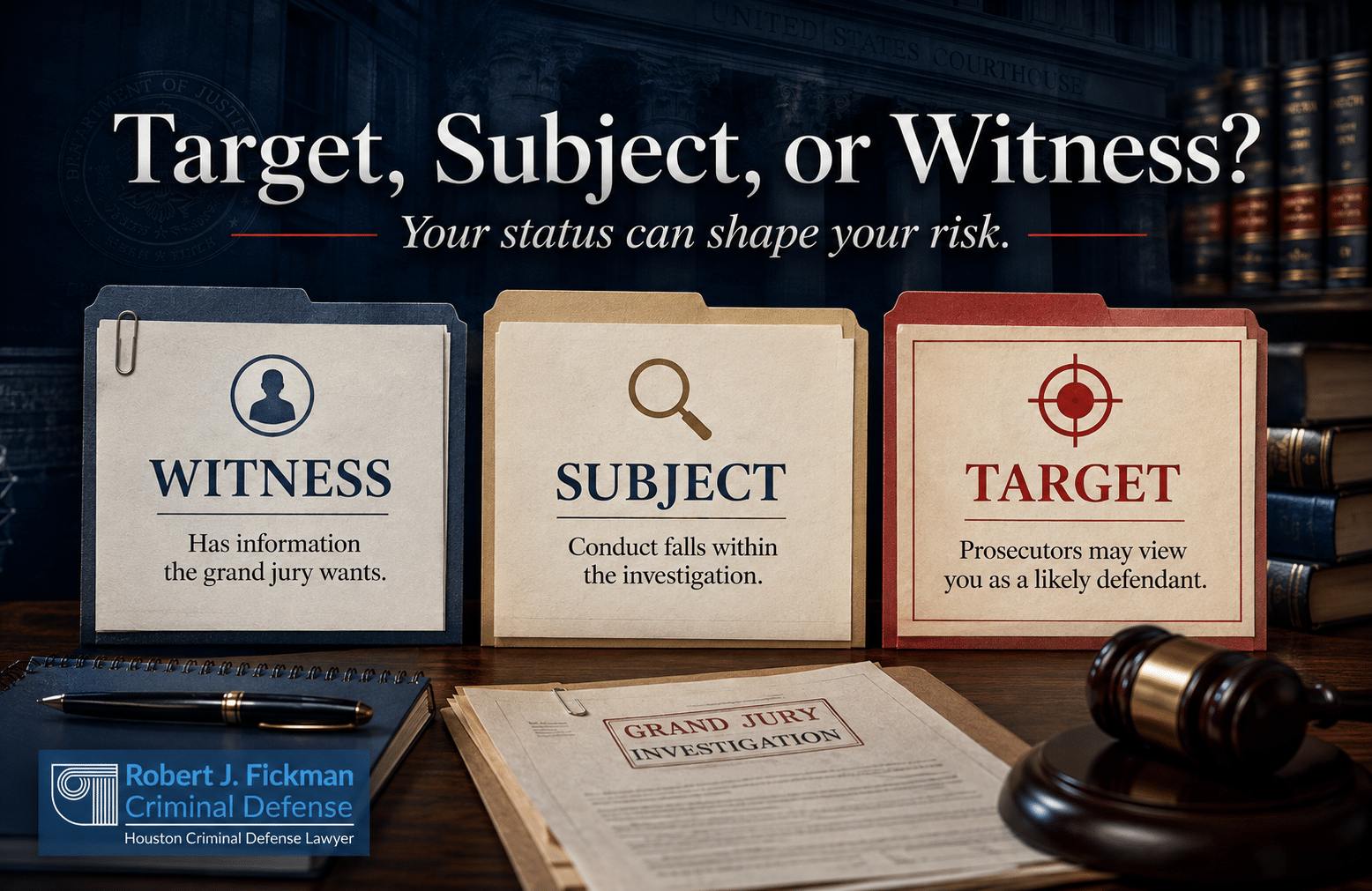
The Department of Justice generally classifies people connected to a federal grand jury investigation as targets, subjects, or witnesses. Those labels matter because they signal how prosecutors may view your role in the investigation.
A target is someone the prosecutor or grand jury believes is linked to the commission of a crime by substantial evidence and who prosecutors view as a putative defendant. Put more simply, a target is someone prosecutors may already be considering for indictment.
A subject is someone whose conduct falls within the scope of the grand jury’s investigation. A subject is not necessarily a likely defendant, but the grand jury is examining their conduct.
A witness is someone who may have information the grand jury wants. A witness may not be suspected of wrongdoing, but their testimony or records may still be important to the investigation.
These categories are not fixed. A witness can become a subject. A subject can become a target. In some situations, defense counsel may be able to communicate with prosecutors, clarify the person’s status, and begin addressing the government’s concerns before charges are filed.
Federal investigations often move quietly for months or even years before a person receives a target letter or subpoena. By the time the government contacts you, prosecutors may already have a theory of the case.
What Is a Federal Grand Jury?
A federal grand jury is a group of citizens that investigates potential federal crimes and decides whether there is probable cause to charge someone by indictment. Grand jury proceedings are not trials. They are investigative and charging proceedings.
Under Federal Rule of Criminal Procedure 6, a federal grand jury can hear testimony, review documents, and issue subpoenas for records or witnesses. If enough grand jurors agree that probable cause exists, the grand jury may return an indictment. If not, charges may not move forward through that grand jury presentation.
Federal grand jury proceedings are secret and one-sided by design. The prosecutor presents evidence and questions witnesses. The defense does not have an automatic right to appear, cross-examine witnesses, object to questions, or present its own evidence inside the grand jury room.
That does not mean a target has no rights. A person who is called to testify keeps the right against self-incrimination. You may refuse to answer a question if a truthful answer could tend to incriminate you. Your lawyer generally cannot stand next to you inside the grand jury room, but you may be allowed to step outside and consult with your lawyer before answering questions.
Target Letter vs. Grand Jury Subpoena
A target letter and a grand jury subpoena are related, but they are not the same thing.
A target letter tells you that prosecutors consider you a target of the investigation. It may identify the general subject matter of the investigation and advise you of certain rights. Treat a target letter as a serious warning that the risk of indictment may be real.
A grand jury subpoena is a legal command. It may require you to testify, produce documents, provide business records, turn over financial information, or produce other evidence. Ignoring a subpoena can create serious consequences.
Some people receive both. Others receive a subpoena without clearly knowing whether they are a witness, subject, or target. Either situation should be handled carefully. Before responding, it is important to know what the government is asking for, whether any privilege applies, whether the subpoena is overly broad, and whether testimony or production could create criminal exposure.
For more background, see Robert J. Fickman’s article on understanding federal grand jury subpoenas in criminal investigations.
What Should You Do After Receiving a Target Letter or Subpoena?
First, remain silent and consult a federal criminal defense lawyer before discussing the matter with agents, prosecutors, coworkers, business partners, friends, or anyone else connected to the investigation.
People often want to explain that everything is a misunderstanding. That instinct can be dangerous. Statements made early can be misunderstood, contradicted by other evidence, or used later by prosecutors.
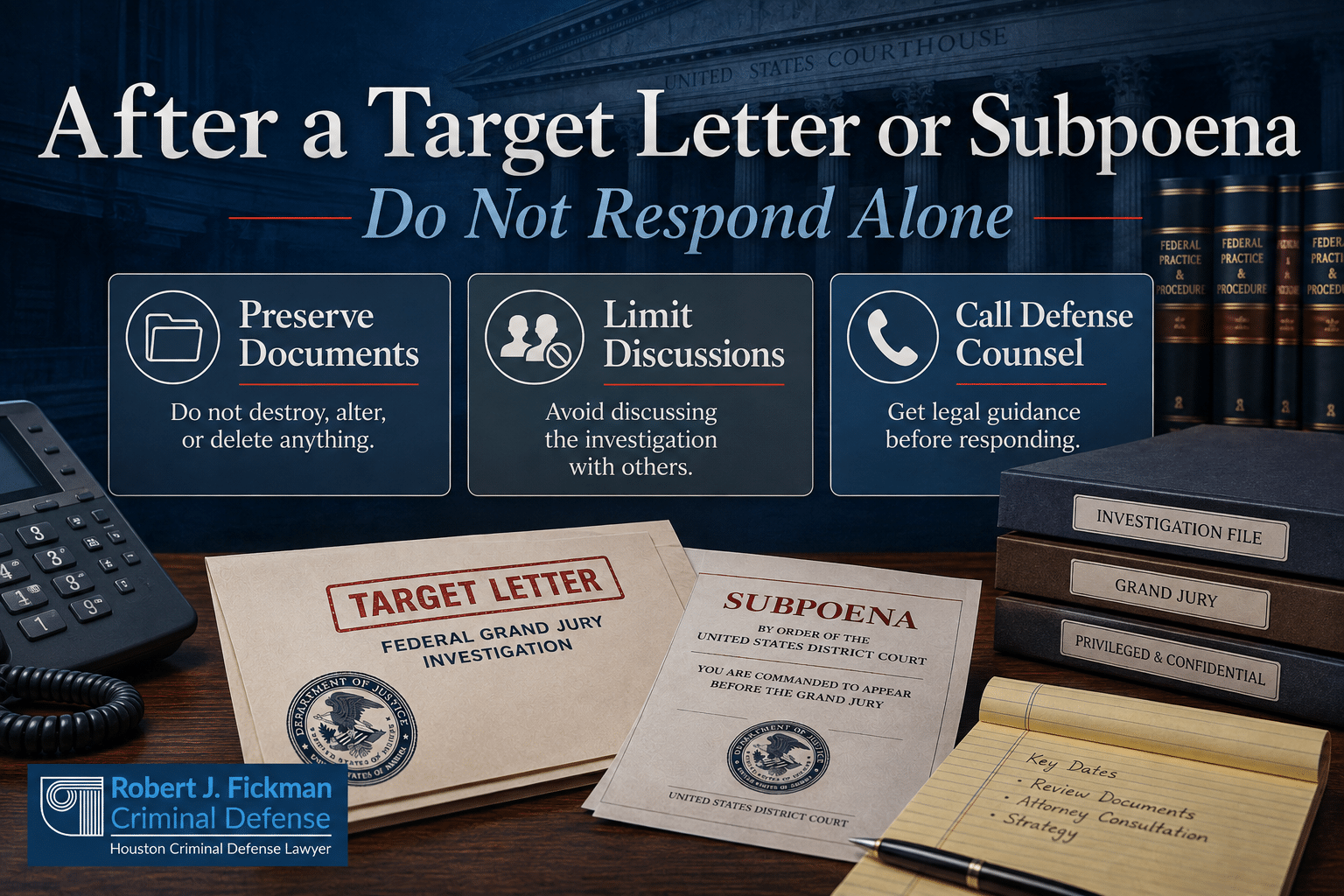
If you receive a target letter or subpoena:
- Do not speak with federal agents without counsel present.
- Do not call the prosecutor yourself.
- Do not try to explain the situation to witnesses or other people involved.
- Do not delete, alter, hide, or destroy documents, emails, text messages, files, or devices.
- Preserve records, phones, computers, financial documents, and business communications.
- Write down what you remember while it is fresh, but share those notes only with your lawyer.
- Do not guess about the meaning of the subpoena or target letter.
- Contact experienced federal defense counsel as soon as possible.
The goal is not to panic. The goal is to protect yourself before a mistake makes the situation worse.
Why You Should Not Speak to Federal Agents Without Counsel
Federal agents may sound calm, friendly, or informal. They may say they only want to “clear things up” or “hear your side.” But if you are a target or possible target, anything you say can be used against you.
Even truthful statements can create problems if they are incomplete, imprecise, or inconsistent with records the government already has. A person who tries to explain a complicated financial transaction, business decision, healthcare billing issue, tax matter, or communications history without preparation may accidentally create more exposure.
There is also a separate risk in making a false statement to federal agents. A person can face criminal exposure for lying to federal investigators even if the underlying investigation does not result in the original charge the government was considering.
A defense lawyer can communicate with prosecutors and agents for you, determine whether an interview is wise, prepare you if any statement is appropriate, and protect you from making unnecessary admissions.
Why You Should Never Destroy Documents or Delete Evidence
Destroying, hiding, altering, deleting, or falsifying records can create a separate federal obstruction problem. That is true even if you believe the underlying accusation is wrong.
People under pressure sometimes think deleting emails, wiping phones, shredding documents, or throwing away files will make the investigation go away. It usually does the opposite. It can make prosecutors believe there was consciousness of guilt and may expose the person to a separate obstruction charge.
Federal law separately addresses the destruction, alteration, or falsification of records in federal investigations under 18 U.S.C. § 1519. This applies to paper records, emails, text messages, accounting files, business records, bank records, electronic devices, cloud storage, and other materials. If a subpoena asks for records, your lawyer can review the demand, identify possible objections or privilege issues, communicate with prosecutors, and help you respond properly.
The safest first step is preservation. Do not destroy anything. Do not ask someone else to destroy anything. Do not “clean up” records. Speak with counsel before taking any action.
How a Houston Federal Criminal Defense Lawyer Can Help Before Indictment
A federal grand jury investigation does not always have to end in an indictment. Early defense work may matter most before charges are filed.
A defense lawyer may be able to:
- Contact prosecutors and clarify your status.
- Review the target letter or subpoena.
- Identify whether you are a witness, subject, or target.
- Protect your Fifth Amendment rights.
- Challenge or narrow overly broad subpoena demands.
- Review documents before production.
- Identify privileged or protected material.
- Coordinate document preservation.
- Investigate facts the government may not know.
- Prepare a defense presentation when appropriate.
- Communicate with prosecutors before indictment decisions are made.
In some cases, defense counsel may provide context, documents, or legal arguments that change how prosecutors view the case. In white-collar, fraud, healthcare, tax, and business-related investigations, the defense work done before indictment can be just as important as the work done after charges are filed.
Robert J. Fickman also represents clients in federal fraud allegations, white-collar crime investigations, and broader federal investigations.
Common Mistakes Targets Make During a Federal Grand Jury Investigation
The early days after receiving a target letter or subpoena are critical. Many people make decisions during that period that later become difficult to undo.
Common mistakes include:
- Calling the agent or prosecutor to explain.
- Talking to coworkers, employees, business partners, or witnesses about the investigation.
- Deleting texts, emails, files, or social media messages.
- Moving money or changing records after learning about the investigation.
- Ignoring a subpoena or missing a deadline.
- Producing documents without a privilege review.
- Assuming innocence means there is no risk.
- Waiting until after indictment to hire federal defense counsel.
Treat a target letter as an opportunity to act before the case reaches its most dangerous stage. Waiting can reduce your defense options.
Federal Grand Jury Investigations in White Collar and Fraud Cases
Federal grand jury investigations are common in fraud, healthcare, bank fraud, tax, public corruption, money laundering, conspiracy, and other white-collar matters. These cases often involve long paper trails, financial records, emails, text messages, witness interviews, and expert analysis.
The government may already have records from banks, employers, business partners, healthcare programs, vendors, customers, or cooperating witnesses. In many cases, a subpoena or target letter arrives only after prosecutors have already spent significant time building the case.
That is why the defense should begin with a careful review of what the government already knows. The best response is usually not a rushed explanation. It is a deliberate strategy based on the documents, the law, the client’s exposure, and the prosecutor’s likely theory.
For businesses and professionals, the stakes may include not only the risk of indictment but also professional licensing, reputation, business operations, financial accounts, and future employment.
A Target Letter Is a Warning: Call a Houston Federal Crime Lawyer
If you are the target of a federal grand jury in Texas, do not wait for charges to be filed before protecting yourself. A target letter or subpoena may be the first direct sign that prosecutors are already looking at you as a potential defendant.
Robert J. Fickman Criminal Defense has represented individuals, professionals, and businesses in federal courts across Texas. If you received a target letter, grand jury subpoena, or contact from federal agents, the firm can review your situation, explain your options, and help you respond before the case moves further.
To discuss your situation confidentially, contact Robert J. Fickman Criminal Defense today.
Frequently Asked Questions
What does it mean to be a target of a federal grand jury?
Being a target means prosecutors or the grand jury believe there is substantial evidence linking you to a possible federal crime and that you may be considered a likely defendant. It does not mean you have already been indicted, but it is a serious warning that you should speak with a federal criminal defense lawyer immediately.
Can I be indicted after receiving a federal target letter?
Yes. A target letter can come before an indictment. It usually means prosecutors are considering charges or believe you are closely connected to the conduct under investigation. Early defense work may help clarify your status, protect your rights, and respond before the case moves further.
Should I testify before a federal grand jury if I am a target?
You should not make that decision without legal advice. Testifying as a target can create serious risk because your statements may be used against you. A defense lawyer can evaluate whether testimony is appropriate, whether the Fifth Amendment applies, and whether another response strategy is safer.
What should I do if I receive a federal grand jury subpoena?
Do not ignore it, but do not respond on your own. Preserve documents, avoid discussing the investigation, and contact a federal criminal defense lawyer. Your lawyer can review the subpoena, communicate with prosecutors, assess privilege issues, and help you respond properly.
Can I destroy documents if I think they look bad?
No. Do not destroy, delete, hide, alter, or throw away documents, emails, text messages, files, or devices. Destroying or falsifying records can create separate obstruction exposure, even if you believe the underlying accusation is false.
Related