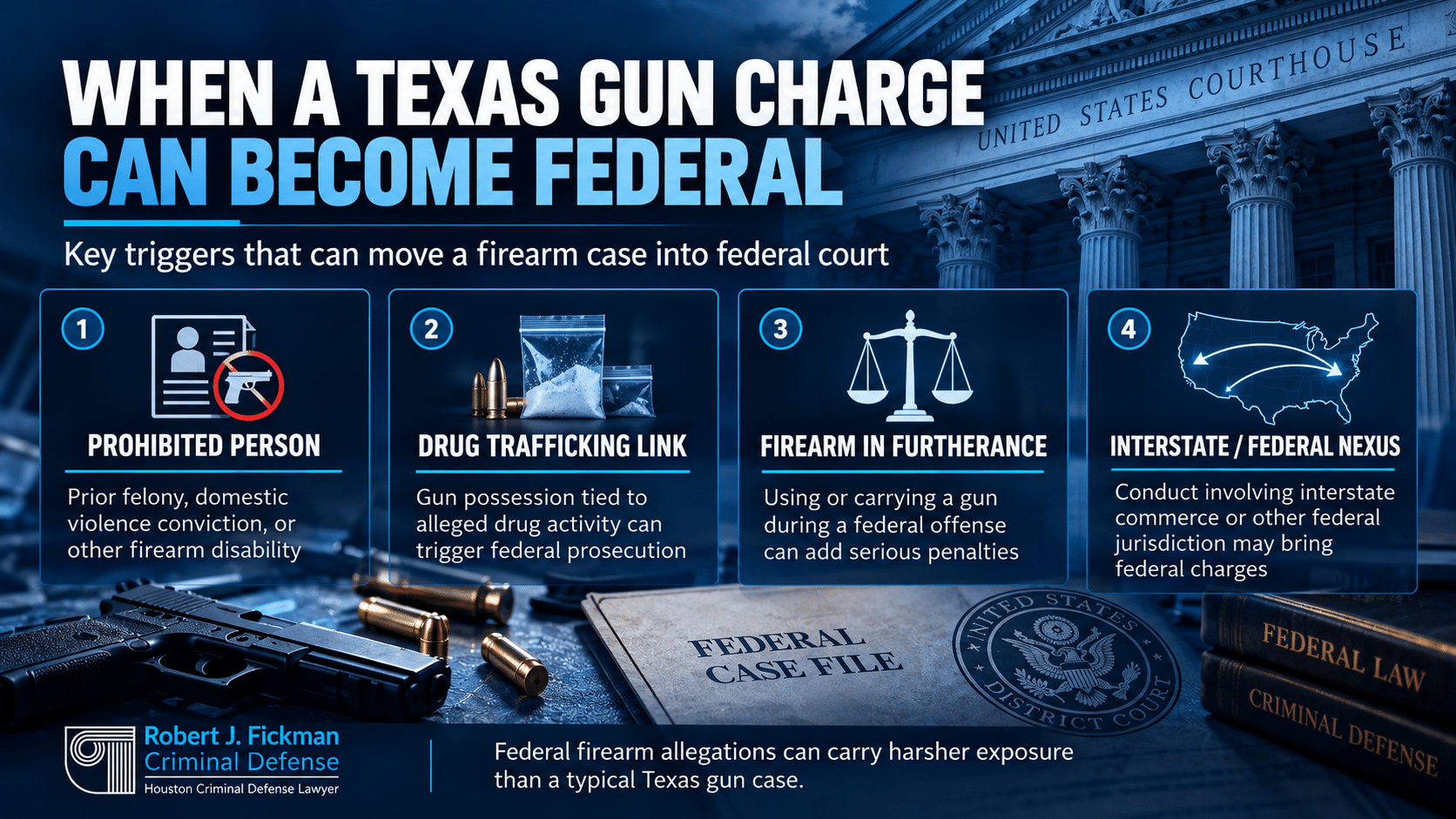
A Texas gun case can become federal because of who possessed the firearm, how they obtained or used it, and whether the conduct violates a federal firearms statute. Texas permitless-carry rules did not repeal federal firearm restrictions, so conduct lawful for one person can expose another to serious federal charges because of prohibited status, an alleged drug offense, a trafficking theory, or another federal connection.
Texas state law does not override federal criminal law. If possession of a firearm is illegal under federal law, federal prosecutors may file charges even if state law appears to allow the conduct.
Determining which law applies, and whether federal agents or prosecutors are already involved, is an early priority for Robert J. Fickman Criminal Defense. Federal firearms cases often begin quietly, and the facts that determine federal exposure may not be obvious at the time of a state arrest. Review every state firearm case to determine whether a federal case may also be filed.
What Turns a Texas Gun Charge Into a Federal Case
Several issues can move a firearms case from a Harris County courtroom into federal court. A person may fall within a federally prohibited category. The firearm may be connected to alleged drug trafficking or another federal offense. Federal agents or task-force officers may already be participating in the investigation. Many federal firearms statutes also require the government to establish the interstate-commerce connection required by the particular offense.
The U.S. Attorney’s Office for the Southern District of Texas handles federal prosecutions in the Houston area. The Houston Division includes Harris County as well as Fort Bend, Montgomery, Waller, and nine other counties.
Federal Gun Charges Filed in Texas Cases
Federal firearm prosecutions commonly involve charges such as:
- Possession by a prohibited person: Federal law prohibits certain categories of people from possessing firearms or ammunition.
- Straw purchasing: A person buys or conspires to buy a firearm for someone else under circumstances covered by federal law.
- Firearms trafficking: The government alleges firearms were transferred or received in circumstances that violate the federal trafficking statute.
- Possession of certain unregistered firearms: Some firearms and devices are regulated under the National Firearms Act and may require registration.
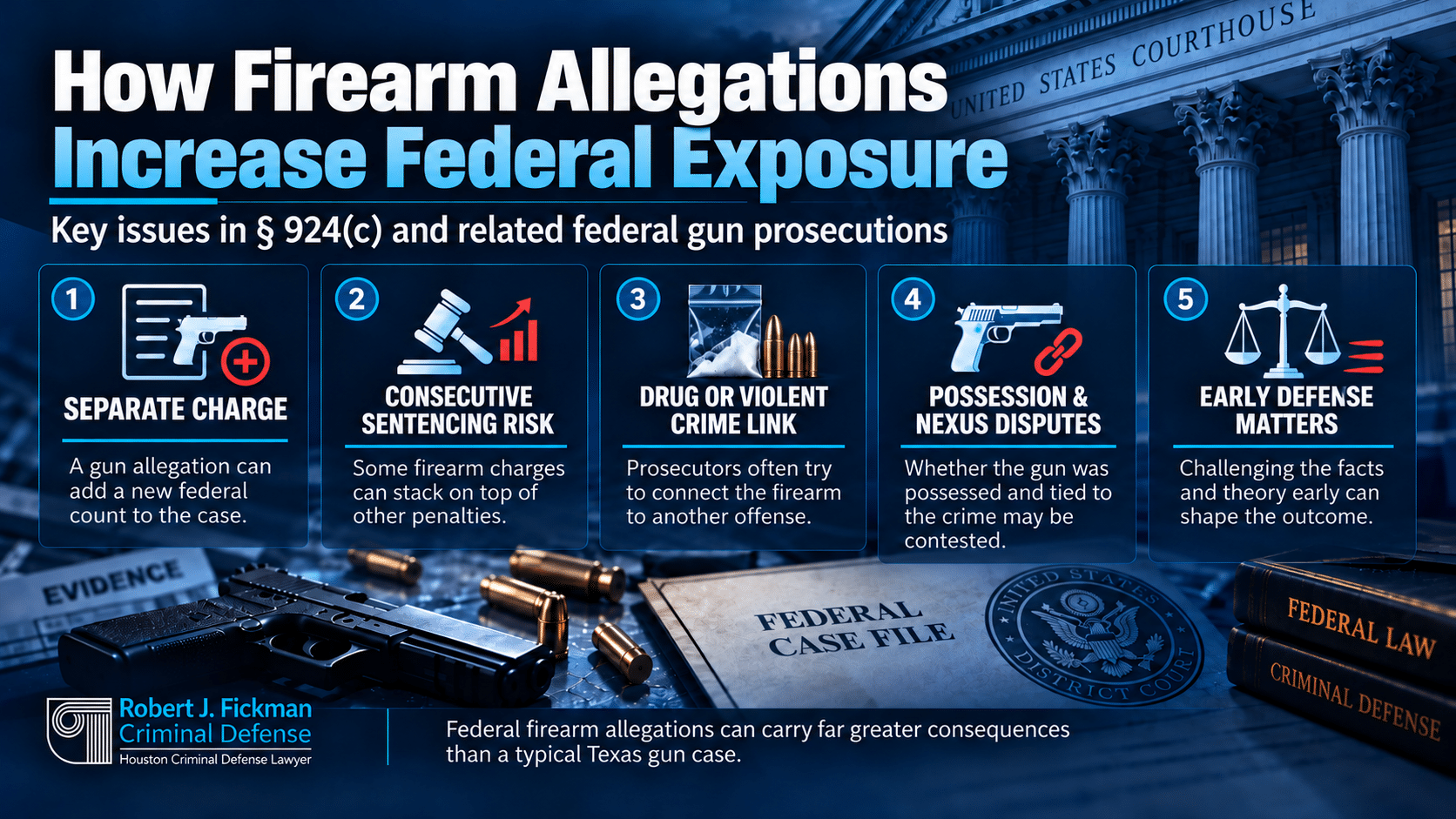
- A firearm count tied to another federal offense: A firearm allegedly used, carried, or possessed in furtherance of a drug trafficking crime or crime of violence can trigger a separate federal count under 18 U.S.C. § 924(c). This is a particularly serious charge because the court may impose a consecutive sentence to the underlying federal offense.
Congress created separate federal offenses for certain straw-purchasing and firearms-trafficking conduct in 2022. Under 18 U.S.C. § 932, qualifying straw-purchase violations generally carry up to 15 years, with a maximum of 25 years in specified cases involving knowledge or reasonable cause to believe the firearm will be used to commit a felony, federal crime of terrorism, or drug trafficking crime. 18 U.S.C. § 933 provides up to 15 years for firearms trafficking. The Justice Department reported that 525 defendants had been charged under the new trafficking and straw-purchasing provisions during the first two years after enactment.
Federal Gun Charges Added to a Texas Drug Case
A firearm count attached to a federal drug case can dramatically increase sentencing exposure. According to the United States Sentencing Commission, every person sentenced for a Section 924(c) conviction in fiscal year 2025 received a prison sentence.
The Commission reported an average sentence of 149 months for all Section 924(c) cases in fiscal year 2025. The average was 80 months for defendants convicted only under Section 924(c) and 142 months for defendants also convicted of another offense without its own mandatory minimum. Eighty-nine percent were convicted of another offense, and 56% of that group were also convicted of drug trafficking.
That is why a federal defense strategy should evaluate the firearm count and the underlying drug allegations together. Mandatory minimums, consecutive sentencing rules, guideline calculations, and other federal sentencing issues can shape the case well before trial.
Who Counts as a Prohibited Person Under Federal Gun Law
Federal law bars several categories of people from possessing firearms or ammunition. The ATF summary of prohibited persons includes, among others, people convicted of crimes punishable by more than one year, unlawful users of controlled substances, certain people subject to qualifying restraining orders, and people convicted of misdemeanor crimes of domestic violence. Federal law also restricts firearm receipt by certain people who are under indictment.
Family-violence situations can create unexpected federal firearm consequences. A qualifying family violence protective order may trigger the federal restriction in 18 U.S.C. § 922(g)(8) while the order remains in effect. In 2024, the U.S. Supreme Court held in United States v. Rahimi that Section 922(g)(8) could constitutionally be applied to a person subject to a qualifying order based on a finding that he posed a credible threat to another person’s physical safety. A qualifying misdemeanor domestic-violence conviction can also trigger a separate federal prohibition.
Because federal consequences can outlast or differ from the state-court case, evaluate firearm eligibility before assuming Texas carry rules answer the federal question.
Defenses to a Federal Gun Charge in Houston
Available defenses depend on the statute and the facts, but several issues often matter in federal firearms cases.
Knowledge of Prohibited Status
For a prosecution under 18 U.S.C. § 922(g), the government generally must prove the defendant knew the facts that placed the person in a prohibited category. The focus is on knowledge of the relevant status, not whether the person knew the legal consequences of that status.
Actual or Constructive Possession
When a firearm is found in a shared vehicle, residence, or other location used by several people, the government still must prove possession. Mere proximity to a firearm does not automatically establish possession.
Search and Seizure Issues
The legality of a stop, search, warrant, or seizure may determine whether the firearm and related evidence can be used. The defense should examine how law enforcement obtained the evidence and whether it met constitutional requirements.
Elements of the Specific Federal Offense
The government must prove every required element of the charged statute, including any interstate-commerce element or connection to another alleged federal offense that the statute requires.
Federal firearms law continues to generate significant litigation. Anyone relying on a recent court decision, news report, or online summary should get advice based on current law and the case’s exact facts.
Find Out If Your Texas Gun Charge Is Going Federal
Robert J. Fickman Criminal Defense has represented clients in serious state and federal criminal matters for more than 40 years. If federal agents are involved, a subpoena has been issued, or a state gun case appears to be developing into a federal investigation, early advice can help clarify the risks and available options.
For broader information about federal cases, see the firm’s Houston Federal Criminal Defense FAQ and Houston Federal Investigation FAQ.
Contact Robert J. Fickman Criminal Defense to discuss the case and bring any available paperwork, including a target letter, subpoena, federal complaint, indictment, or state charging documents.
Related