Federal securities fraud investigations usually begin quietly, months before anyone hears the word “charges.” In many cases, the first sign is indirect: a business partner mentions being asked questions, an employer starts pulling records, a compliance department begins reviewing trading activity, or a subpoena arrives with little explanation. By then, the matter may already have moved through stages the person under review never saw.
Anyone in Harris County who suspects they are under securities scrutiny should treat the situation seriously. Robert J. Fickman Criminal Defense represents individuals, executives, professionals, and businesses in white-collar crime investigations and federal criminal matters in Houston and throughout Texas.
Early defense involvement can matter because securities investigations often involve both civil regulators and federal prosecutors. What a person says to an employer, regulator, investigator, or agent can affect the direction of the case long before an indictment is filed.
How Federal Securities Fraud Investigations Start
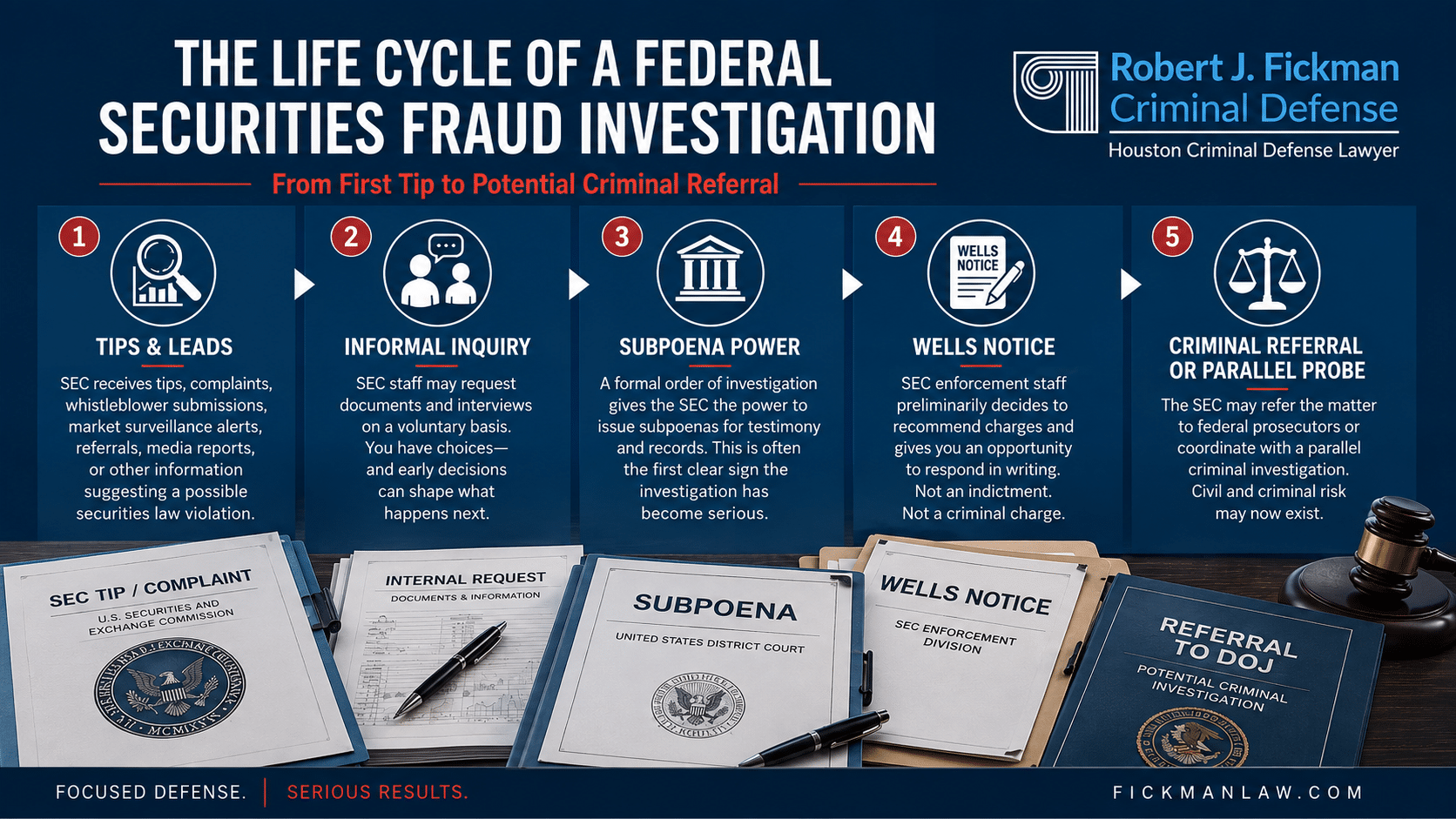
Federal securities fraud investigations often start when the Securities and Exchange Commission receives information suggesting a possible violation of the federal securities laws. The SEC explains that its Enforcement Division investigates possible violations and may recommend civil enforcement actions, while also working with criminal law enforcement authorities when appropriate.
Those leads can come from several sources, including:
- Investor tips, complaints, and referrals.
- Whistleblower submissions.
- Market surveillance that flags unusual trading activity.
- Referrals from SEC examination staff or other SEC offices.
- Self-regulatory organizations, industry sources, or FINRA-related issues.
- Media reports, public filings, or suspicious company disclosures.
- Parallel business disputes, employment disputes, or internal investigations.
The SEC provides a public process for submitting tips, complaints, and referrals about possible securities law violations. That means a Houston company, executive, broker, investor, or employee can come onto the agency’s radar without knowing who first raised the issue.
Investigations are generally confidential, and the agency may not confirm or deny that one exists. For the person or company under review, that means most of the investigation’s life cycle may occur out of sight.
From Voluntary Inquiry to Subpoena Power
Many securities investigations begin informally. During an informal inquiry, staff may ask for documents, interviews, explanations, or records voluntarily. Because informal requests are not the same as subpoenas, the person or company receiving the request may have choices about how to respond. Those choices should not be made casually.
The investigation changes once the Commission issues a formal order of investigation. The SEC explains that, with a formal order, Enforcement staff may compel witnesses by subpoena to testify and produce books, records, and other relevant documents. A subpoena is often the practical signal that the matter has become more serious.
A subpoena may seek emails, trading records, bank records, investor communications, board materials, accounting documents, offering materials, personal devices, or testimony. Before responding, defense counsel should review the demand, preserve potentially relevant materials, evaluate privilege issues, and consider whether the request signals civil exposure, criminal exposure, or both.
For more background on subpoenas in federal investigations, see Robert J. Fickman’s article on understanding federal grand jury subpoenas in criminal investigations.
What a Wells Notice Means
A Wells notice usually comes later in an SEC investigation. It means enforcement staff has made a preliminary decision to recommend an enforcement action and is giving the recipient an opportunity to submit a written response explaining why charges should not be brought or why the proposed charges should be narrowed.
A Wells notice is not an indictment. It is not a criminal charge. The SEC is a civil enforcement agency. However, a Wells notice can still be a major warning sign because the same facts the SEC reviews may also interest federal prosecutors. Other government actors may later review a written Wells submission, so it should be prepared carefully.
The SEC announced updates to its Enforcement Manual in 2026 intended to provide more consistent Wells process timing, including that recipients of a Wells notice will ordinarily receive four weeks to make Wells submissions. That process can give counsel an opportunity to address the government’s theory before the matter moves further.
What Conduct Can Trigger Securities Fraud Scrutiny?
Securities fraud is a broad term. In civil cases, the SEC frequently relies on Rule 10b-5, which prohibits manipulative or deceptive conduct, material misstatements or omissions, and fraudulent practices in connection with the purchase or sale of securities. Criminal prosecutors may also use 18 U.S.C. § 1348, the federal securities and commodities fraud statute, along with other fraud-related statutes.
In a Texas white collar case, securities scrutiny may involve allegations such as:
- Misleading investors about company finances, risk, revenue, or business performance.
- False or incomplete offering materials.
- Insider trading or trading based on material nonpublic information.
- Market manipulation or coordinated trading activity.
- Ponzi-like investment allegations.
- Misuse of investor funds.
- False statements in public filings or private investor communications.
- Accounting fraud or improper revenue recognition.
- Broker, adviser, or fiduciary-related misconduct.
The defense usually begins by identifying exactly what the government claims was false, misleading, omitted, deceptive, or unauthorized. In many cases, the dispute is not simply whether a loss occurred. The question is whether the government can prove fraud, intent, materiality, and the connection to a securities transaction.
When a Houston Securities Case Reaches Federal Prosecutors
Criminal exposure enters a Houston securities matter when the SEC refers a potential criminal matter to law enforcement authorities or coordinates alongside a parallel criminal investigation of the same conduct. The SEC’s own description of its Enforcement Division recognizes that the Division works closely with law enforcement agencies to bring criminal cases when appropriate.
The same facts can produce both a civil SEC enforcement action and a federal prosecution. Testimony, documents, admissions, or explanations given on the civil side may later matter on the criminal side. That is why counsel should evaluate possible criminal exposure before a person responds to regulators, internal investigators, or federal agents.
Houston-area federal cases are handled in the Southern District of Texas. The United States Attorney’s Office for the Southern District of Texas has divisions in Houston, Galveston, Victoria, Corpus Christi, Brownsville, McAllen, and Laredo, and federal court proceedings in Houston fall within the Houston Division.
The crossover between civil and criminal exposure is common enough in business matters that a contract dispute, partnership dissolution, investor complaint, regulatory audit, or internal review can become the moment civil issues begin moving toward a criminal investigation. Robert J. Fickman has also written about what to do if you think you may be under federal criminal investigation.
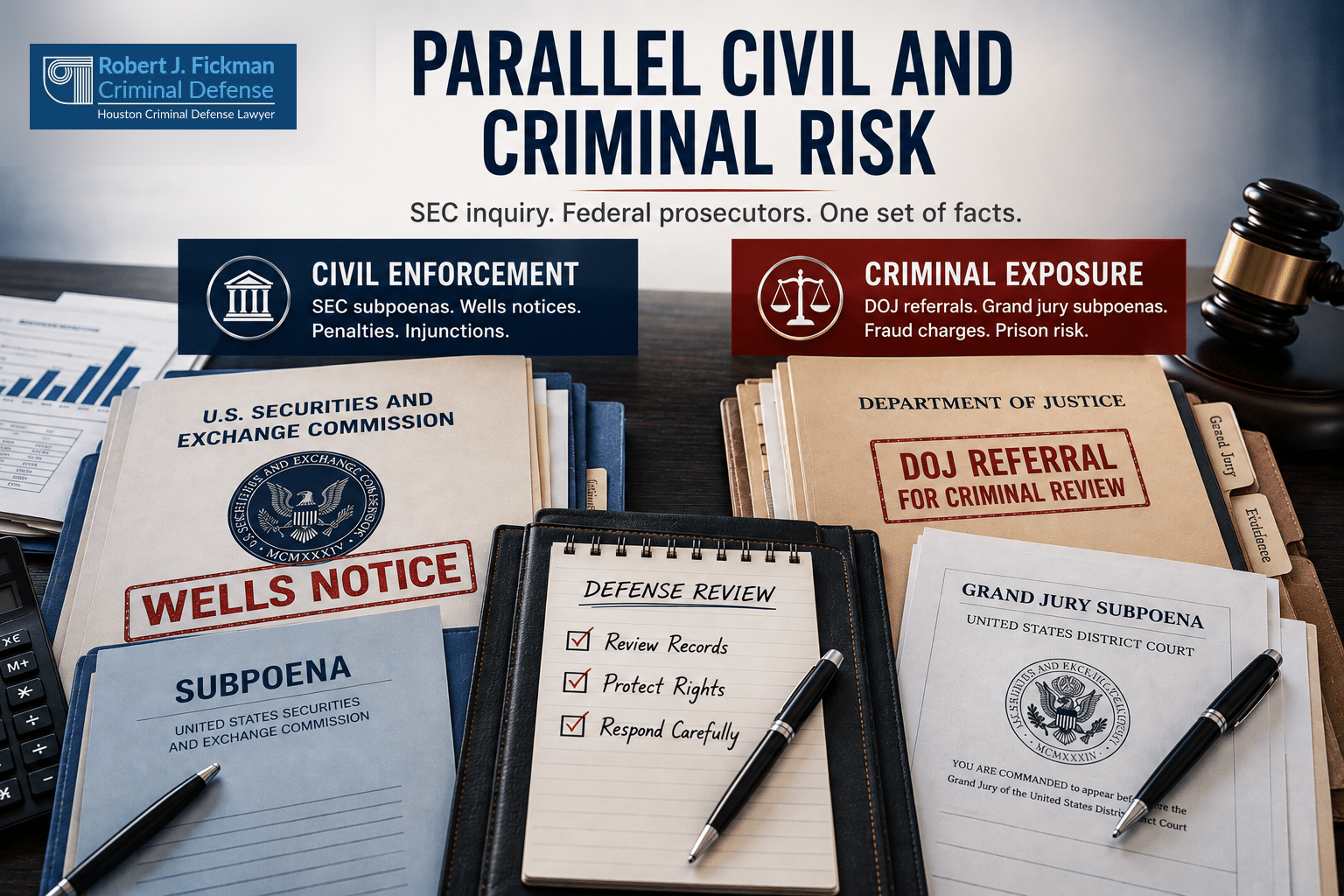
Parallel Civil and Criminal Risk in Securities Matters
Securities allegations rarely travel alone once prosecutors are involved. A case that begins as a securities inquiry may expand into wire fraud, mail fraud, money laundering, conspiracy, false statements, obstruction, tax issues, or bank-record disputes. Each possible charge has its own proof requirements and its own strategic concerns.
That matters because a weak securities theory sitting next to a stronger wire fraud or false statement allegation changes the defense calculation. A person under review should not assume the label “securities fraud” captures the entire case. A federal defense lawyer should read the full set of allegations, records, communications, subpoenas, and government theories together.
The government may also use grand jury subpoenas to obtain documents and testimony before charges are filed. In those situations, the person receiving the subpoena may not know whether they are viewed as a witness, subject, or target.
Target, Subject, and Witness Status in Federal White Collar Cases
Once a federal grand jury is involved, prosecutors may describe people connected to the investigation as targets, subjects, or witnesses. Those classifications matter because they signal how prosecutors may view a person’s exposure.
- A target is someone prosecutors or the grand jury believe is linked to a crime by substantial evidence and may be treated as a putative defendant.
- A subject is someone whose conduct falls within the scope of the investigation.
- A witness is someone who may have information but is not necessarily suspected of wrongdoing.
A target letter is a notification of status, not an indictment and not a charge. Prosecutors send target letters at their discretion, not in every case. If a target or subject is called to testify, the person may be advised of the general subject matter of the investigation, the right to refuse self-incriminating answers, that statements can be used against them, and that counsel is available outside the grand jury room.
For more on this issue, see Robert J. Fickman’s post, What to Do If You Are a Target of a Federal Grand Jury in Texas.
Why Early Defense Involvement Matters
Timing shapes options in federal white-collar matters. The quietest phase is often where the most can still be done. Before charges are filed, defense counsel may be able to communicate with regulators or prosecutors, preserve records, identify weaknesses in the government’s theory, prepare witnesses, review documents, and address misunderstandings before they harden into allegations.
Early counsel can also help clients avoid common mistakes, including:
- Speaking to investigators without preparation.
- Giving inconsistent explanations to employers, regulators, or agents.
- Destroying, deleting, or altering records.
- Making a Wells submission without considering criminal exposure.
- Treating a civil subpoena as harmless.
- Assuming that a business dispute cannot become a criminal case.
- Waiting until after indictment to involve federal defense counsel.
In a securities fraud investigation, the defense should focus on the government’s theory of deception, the documents supporting or undermining that theory, the client’s intent, the role of market conditions or business judgment, and whether the loss or investor harm calculation is supported.
Talk to a Houston White Collar Crime Lawyer Before the Subpoena Lands
If questions about your business, trading activity, investor communications, offering materials, or financial records have started to feel like something more than routine, do not wait until charges are filed. A federal securities fraud investigation may already be developing quietly.
Robert J. Fickman Criminal Defense represents people facing federal securities scrutiny, white collar investigations, and grand jury subpoenas across Houston and Harris County. The firm can evaluate the government’s theory, review subpoena demands, assess civil and criminal exposure, and help you respond strategically.
To discuss your situation confidentially, contact Robert J. Fickman Criminal Defense today.
Frequently Asked Questions
How do federal securities fraud investigations usually begin?
Federal securities fraud investigations often begin with SEC tips, investor complaints, whistleblower reports, market surveillance, referrals from other regulators, public filings, or media reports. Many investigations develop quietly before the person under review receives a subpoena, Wells notice, or contact from federal authorities.
Does an SEC subpoena mean I will be charged with a crime?
No. An SEC subpoena does not automatically mean criminal charges will be filed. It may be part of a civil enforcement investigation. However, the same facts can create criminal exposure if the SEC refers the matter to prosecutors or if a parallel criminal investigation is already underway.
What is a Wells notice?
A Wells notice is a communication from SEC enforcement staff stating that staff has made a preliminary decision to recommend an enforcement action. It gives the recipient an opportunity to submit a response before the SEC decides whether to proceed. A Wells notice is not an indictment, but it should be taken seriously.
Can a civil securities investigation become a criminal case?
Yes. A civil SEC investigation can overlap with or lead to a criminal investigation when prosecutors believe the conduct may involve intentional fraud, insider trading, false statements, money laundering, conspiracy, obstruction, or other federal offenses.
Should I speak with investigators before hiring a lawyer?
You should speak with a federal criminal defense lawyer before answering questions from regulators, prosecutors, federal agents, employers, or internal investigators. Statements made early can affect both civil and criminal exposure, even before charges are filed.
Related