Federal identity theft and synthetic fraud cases often begin long before a person is arrested or formally charged. These investigations may grow out of data trails, financial records, device logs, account activity, IP addresses, and patterns that investigators believe connect a person to fraudulent conduct.
By the time a case reaches federal court, prosecutors may already have months’ worth of digital evidence, financial documents, witness statements, and agency analyses. That can make the case feel overwhelming, especially when the government’s theory depends on technical records that do not always tell a complete or accurate story.
Federal identity-related charges may involve statutes such as 18 U.S.C. § 1028, which addresses fraud and related activity involving identification documents, authentication features, and information, or 18 U.S.C. § 1028A, which addresses aggravated identity theft. Federal criminal defense attorney Robert J. Fickman begins by examining how the government built its version of events. In identity theft and synthetic fraud cases, the first question is not simply what the government claims happened. The more important question is whether the evidence actually proves who was responsible, what they knew, and whether they acted with criminal intent.
Strategic Defense Approaches Against Federal Identity Theft and Synthetic Fraud Charges
Federal identity theft and synthetic fraud cases are rarely won or lost on a single issue. These cases often involve multiple layers of evidence, including financial records, digital accounts, account-opening data, electronic communications, device records, and identity information. A strong defense may require challenging the government’s case from several directions at once.
The following are common defense issues in federal identity theft and synthetic fraud cases.
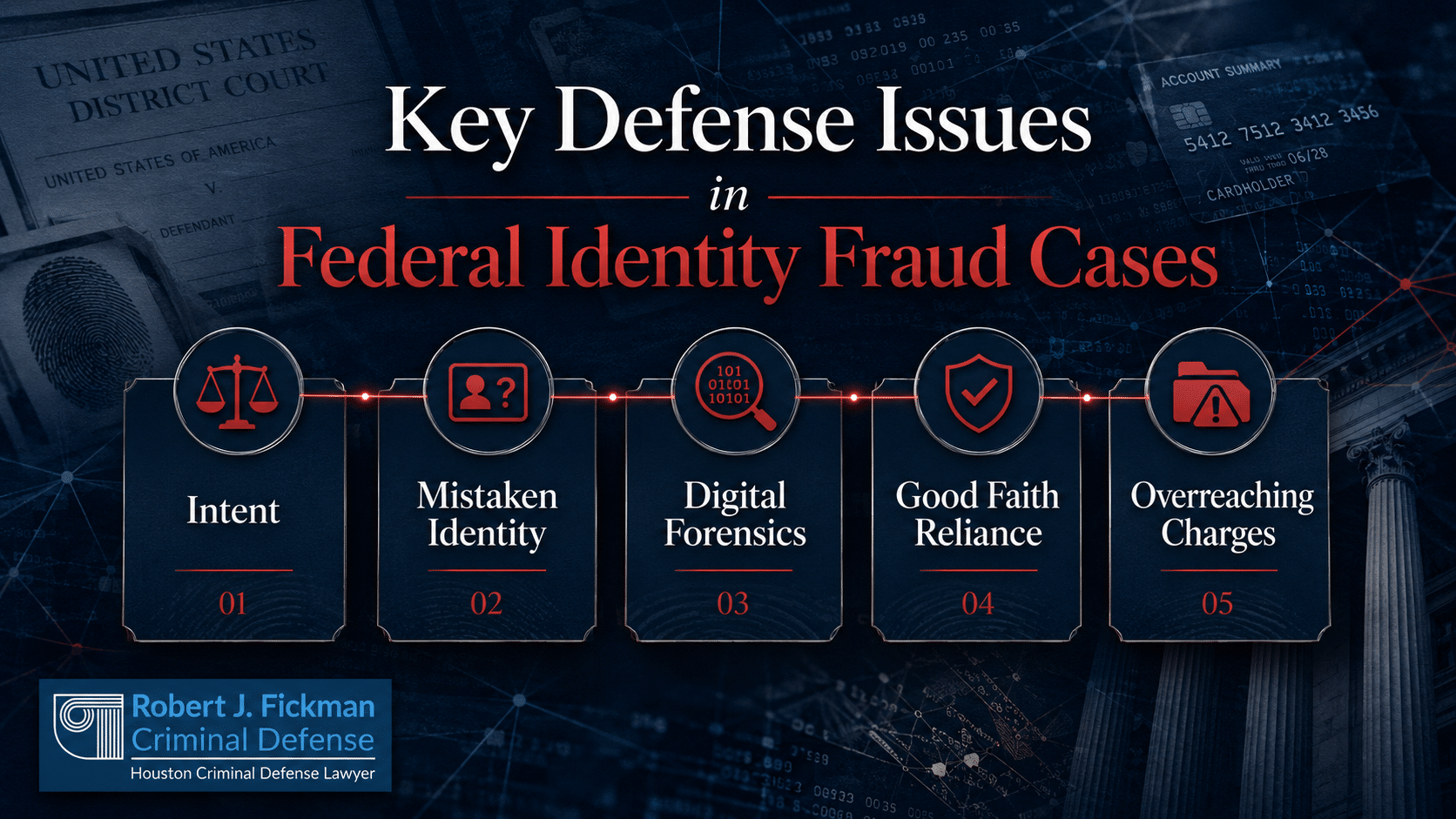
Attacking the Element of Intent
Intent is one of the most heavily contested issues in federal criminal defense cases involving fraud. The U.S. Department of Justice describes identity theft and identity fraud as conduct that may be prosecuted under multiple federal statutes, but prosecutors must still prove more than mere suspicious activity or a bad outcome. They must show that the accused knowingly and willfully participated in a scheme to defraud or misuse another person’s identity.
Many cases turn on whether the government can connect specific actions to deliberate criminal intent rather than assumption, negligence, confusion, or misunderstanding. Defense strategies may focus on alternative explanations for account activity, shared access, inaccurate records, or circumstances in which the conduct does not align with the government’s theory of fraud.
Challenging Mistaken Identity
Identity-based allegations can quickly become complicated, especially when a case involves digital accounts, shared devices, public Wi-Fi, household computers, business systems, or overlapping personal data. One defense approach is to challenge whether the accused was accurately linked to the conduct in question.
This may involve reviewing login records, IP addresses, device histories, account creation data, email records, phone records, and financial activity to assess the reliability of the government’s attribution. In some cases, the issue is not only what happened. The issue is whether the government has correctly identified who actually did it.
For example, if a guest uses a person’s computer or internet connection to commit an illegal activity, investigators may initially assume that the account holder or homeowner was responsible. Showing who had access to the device, when the access occurred, and whether someone else could have used the system may become an important part of the defense.
Evaluating Chain of Evidence and Digital Forensics
Federal fraud cases often rely heavily on digital evidence. That makes the integrity of the evidence critical. Defense review may focus on how information was collected, preserved, stored, searched, interpreted, and presented.
This can include examining whether there were gaps in documentation, problems with the chain of custody, incomplete records, device-access issues, potential contamination, or assumptions made during forensic analysis. If the digital evidence was not handled properly, or if the government’s conclusions go beyond what the data actually proves, the defense may be able to challenge the reliability of the prosecution’s case.
Good Faith Reliance
Not every disputed transaction or account activity is proof of fraud. In some situations, a person may have acted based on information they believed was legitimate at the time. A defense based on good faith reliance focuses on whether the accused reasonably relied on instructions, representations, documents, systems, or other people that later turned out to be inaccurate, incomplete, or misleading.
This defense can be especially important in financial, business, or account-related cases where multiple people are involved in decision-making or where the accused did not personally create, control, or understand every piece of information used in a transaction.
Discrediting Overreaching Charges
Federal investigations can cast a wide net. Prosecutors may attempt to charge conduct as part of a larger alleged scheme even when the evidence against a particular person is limited. A defense strategy in these situations may involve narrowing the scope of responsibility and challenging whether the allegations are being expanded beyond what the evidence actually supports.
This may require separating distinct events, clarifying timelines, distinguishing direct involvement from mere association, and identifying where the government’s theory relies on inference rather than proof. In serious white collar crime cases, the difference between participation and proximity can be critical.
Exploring Every Legal Off-Ramp
Most federal fraud cases do not proceed to trial. Depending on the facts, there may be opportunities to pursue a more favorable resolution, including negotiated charge reductions, cooperation-based agreements, sentencing mitigation, or other available outcomes.
Available options depend on the strength of the evidence, the stage of the case, the client’s history, the alleged loss amount, the role attributed to the client, and prosecutorial discretion. A defense lawyer must evaluate not only whether the government can prove its case, but also which legal and strategic options may still be available.
Why Early Defense Matters in Federal Identity Theft and Synthetic Fraud Cases
Federal identity theft and synthetic fraud allegations can move quickly once charges are filed. However, important defense decisions often need to be made long before trial. Early representation may help protect rights, preserve evidence, evaluate the government’s theory, respond to subpoenas, and avoid statements or decisions that could later harm the defense.
If you believe you may be under investigation, you may also want to review what to do if you think you are involved in a federal criminal investigation. Understanding the investigation stage can be just as important as responding to charges after they are filed.

Take the Next Step in a Federal Fraud Case
Federal identity theft and synthetic fraud cases require careful review of the government’s evidence, the digital record, the financial trail, and the assumptions connecting a person to the alleged conduct. The sooner the defense begins examining those issues, the better positioned the accused may be to understand the risks and available options.
If you are facing a federal investigation or charges in Texas, Robert J. Fickman Criminal Defense can help you understand how the government is building its case and where the weaknesses may be. For broader answers about federal charges, investigations, and defense strategy, visit the firm’s Houston federal criminal defense FAQ.
If you are under investigation or have been charged with a federal identity theft, synthetic fraud, wire fraud, or related offense, contact Robert J. Fickman as soon as possible to discuss your case and protect your rights.
Related