Jun
6
2026
What Happens When the FBI Investigates a Business in Texas
FBI agents do not typically show up at a business on day one of an investigation. They typically show up after months of investigation involving the issuance of subpoenas, witness interviews, and document review. They typically show up without any advance notice at a business or a business owner’s home only after they have already developed an incriminating theory of the case. Robert J. Fickman Criminal Defense has spent 40 years representing businesses and individuals in the Southern District of Texas. Robert Fickman is an established and experienced Houston federal criminal defense lawyer. He has handled cases where his early engagement kept clients from ever being charged with any criminal offense. On an ongoing basis, he represents Houstonians who are under Federal investigation.
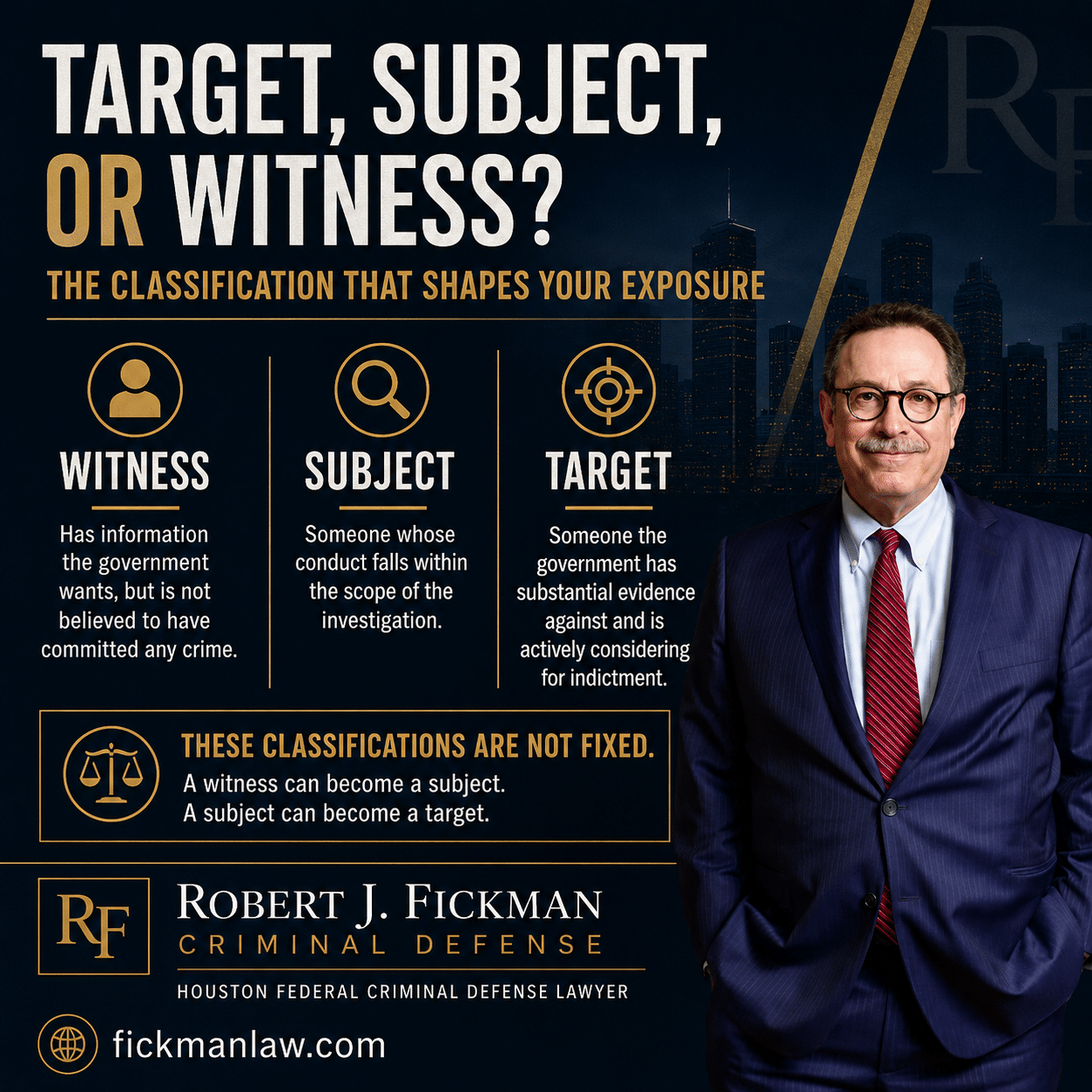
Target, Subject, or Witness: The Classification That Shapes Your Exposure
The federal government classifies everyone connected to an investigation in one of three ways:
- Witness: Has information the government wants, but is not believed to have committed any crime
- Subject: Someone whose conduct falls within the scope of the investigation
- Target: Someone the government has substantial evidence against and is actively considering for indictment
Those classifications are not fixed. A witness can become a subject. A subject can become a target. And the government is not required to tell you which category you currently occupy. However, the Government often sends a target letter to a Federal target to initiate communication between the target’s federal criminal defense lawyer and the Federal prosecutors.
When the FBI is investigating your business, it is common for your employees, vendors, and partners to be contacted by the FBI. How each person responds shapes the investigation in real time. It is the legal right of every person under federal investigation to retain a federal criminal defense lawyer. As a general rule, a target should not talk to anyone about his case other than his lawyer. It is inherently dangerous for a target to communicate with anyone connected to the case. The target may later be accused of witness tampering or obstruction of justice. While the target should not communicate with third parties, there is no prohibition on a target’s lawyer communicating with other lawyers representing other parties connected to the matter, particularly to investigate common defenses.
How Federal Business Investigations Actually Unfold
Federal investigations rarely announce themselves. The first signs are often indirect: a vendor mentions a government contact, a former employee has been interviewed, or subpoenas have been served on a bank or records custodian. By the time agents appear in person, the investigation has typically been running for months.
Federal white-collar charges, documented in the FBI’s white-collar program, include corporate fraud, securities crimes, healthcare fraud, Medicare fraud, hospice care fraud, mortgage fraud, and money laundering, often pursued through multi-agency task forces with the FBI and the IRS.
Houston’s United States Attorney’s Office is one of the most active in the country, handling hundreds of criminal cases annually. Houston’s Assistant United States Attorneys are well-trained, intelligent prosecutors, and their ability to secure a conviction should never be underestimated.
A federal business investigation typically moves from document requests and grand jury subpoenas to agent interviews and, in some cases, a search warrant.
When Federal Agents Show Up at Your Business
The moment agents arrive and want to speak with anyone, two rules should logically apply without exception.
- First: no one should speak to federal investigators without first consulting an attorney. Anything said to a Federal agent, even something the speaker believes is helpful, can be used against them. Agents are trained to identify inconsistencies across interviews, and a statement that contradicts a document in their file can create liability where none existed before.
- Second: preserve everything. Once a business becomes aware of a federal investigation, a legal hold is in effect. Deleting emails, moving files, or altering records at that point creates separate criminal exposure for obstruction, regardless of whether the underlying conduct is ever charged.
Defense counsel experienced in federal white-collar criminal defense can instruct employees on their rights, establish a document preservation protocol, and communicate with Federal Agents on the owner’s or the company’s behalf.
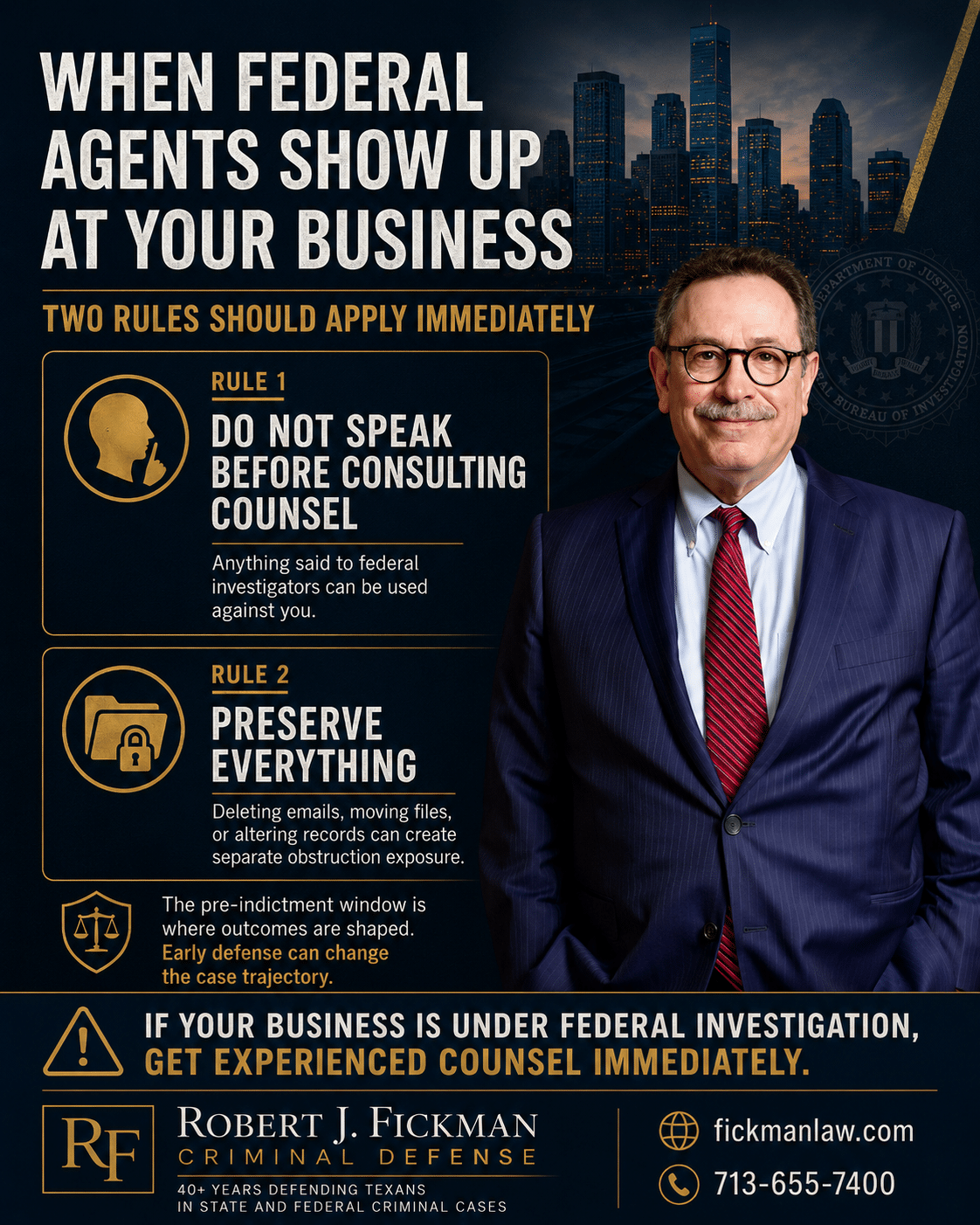
The Pre-Indictment Window Is Where Outcomes Are Shaped
Federal business investigations typically run one to three years before charges are filed. That time span is important. That time should be used to investigate and build any potential defense. It should not be dead time. Every business owner Robert Fickman represents takes a different path, but the initial decisions outlined in steps during a federal investigation apply across all of them: retain counsel, preserve records, and do not speak to agents before you know where you stand.
Robert Fickman is an experienced Houston federal criminal defense attorney who has practiced in the Southern District of Texas for decades. He understands how local Federal prosecutors approach these cases, what they prioritize, and when direct engagement before charges are filed can change the outcome.
The earlier defense counsel is involved, the more that counsel can do: assess the evidence, engage prosecutors before a final charging decision is made, and present facts that challenge the government’s theory before the indictment is written.
Reach a Houston Federal Criminal Defense Attorney Who Has a Proven Track Record Demonstrating the Ability to Defend and Win a Federal Criminal Trial
In 2022, Federal Criminal Defense Attorney Robert Fickman secured the only acquittal on all charges in the multi-defendant “Operation Wrecking Ball” Case. In United States v. Rebolledo, Robert Fickman was the only lawyer to secure an acquittal on all charges filed against his client. That result came from nearly 40 years of practice in the Southern District and a direct understanding of how federal prosecutors build and evaluate their cases.
Robert Fickman has an AV Preeminent rating from Martindale-Hubbell; that rating has been steadily maintained for more than 20 years. Robert Fickman has been invited on many occasions by the National Association of Criminal Defense Lawyers and other defense bar associations to teach at criminal defense seminars. He has taught other federal criminal defense lawyers how to cross-examine a cooperating witness in San Francisco, Las Vegas, Chicago, Houston, Austin, Memphis, and other locations in Florida and Maine. If your business is facing FBI scrutiny or you have received a target letter or grand jury subpoena, Robert J. Fickman Criminal Defense is ready to engage immediately. Contact us online to schedule a consultation.
Related