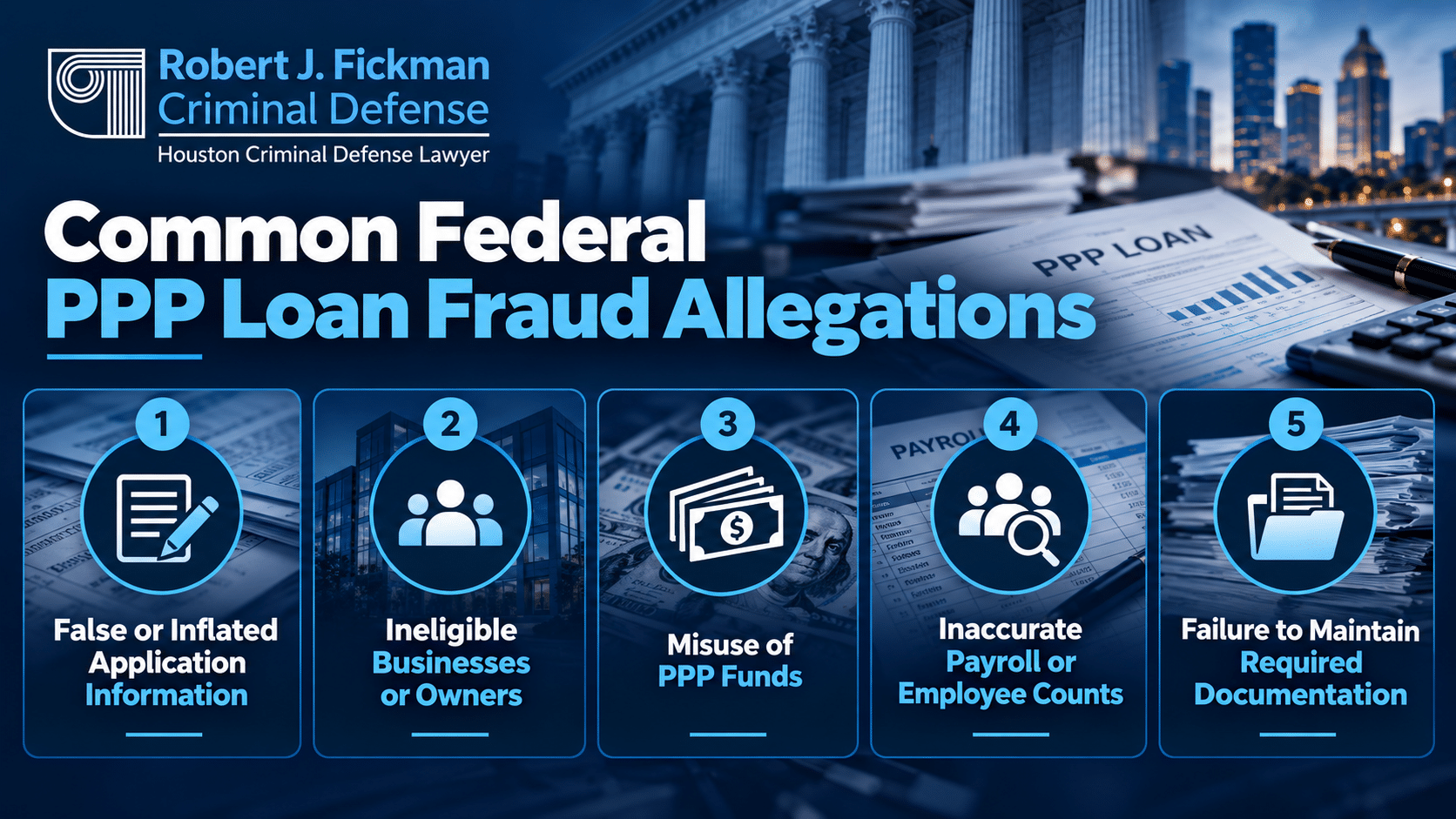
No federal crime is formally called “PPP fraud.” Prosecutors usually charge Paycheck Protection Program loan allegations under existing federal offenses such as wire fraud, bank fraud, false statements, money laundering, conspiracy, and sometimes aggravated identity theft. Each charge has its own elements, potential penalties, and defense issues, and prosecutors may file several counts together rather than treating the PPP loan issue as a single allegation.
That is why the defense should begin by examining the full set of allegations together. Robert J. Fickman Criminal Defense represents individuals, business owners, professionals, and companies in federal fraud investigations, white collar criminal cases, and SBA and PPP fraud matters in Houston and throughout Texas.
If you received a subpoena, were contacted by agents, received a forgiveness denial, or learned that a PPP or EIDL loan is under review, you should speak with a federal criminal defense lawyer before responding. Early defense involvement can help protect your rights, preserve records, and identify whether the government can actually prove criminal intent.
What Federal Prosecutors Actually Charge in a Texas PPP Case
Charging decisions often follow the paperwork. PPP applications moved electronically, lenders were private financial institutions, forgiveness required certifications, and loan proceeds frequently moved through business or personal accounts. As a result, one loan can support several prosecution theories.
Federal PPP loan fraud allegations may involve:
- Wire fraud: Applications, communications, certifications, and funds often moved electronically.
- Bank fraud or false statements to a lender: PPP loans were commonly processed through private financial institutions.
- False statements to the government: These allegations may arise from forgiveness certifications, SBA submissions, or statements made to federal investigators.
- Money laundering: Prosecutors may allege that loan proceeds were moved, concealed, or spent in ways that support separate financial-crime charges.
- Conspiracy: Prosecutors may add a conspiracy charge when they believe multiple people participated in the alleged scheme.
- Aggravated identity theft: The government may add this charge when it alleges that another person’s name, Social Security number, EIN, or other identifying information was unlawfully used. A conviction can add a mandatory consecutive two-year sentence.
Prosecutors may also combine Economic Injury Disaster Loan (EIDL) allegations with PPP-related counts. What begins as a review of a payroll loan application may expand into bank records, tax filings, payroll reports, business records, and communications with lenders or federal agents.
Why a 2020 PPP Loan Application Can Still Be Charged Today
The PPP and Bank Fraud Enforcement Harmonization Act of 2022 extended the statute of limitations for certain borrower fraud involving covered PPP loans. A related law, the COVID-19 EIDL Fraud Statute of Limitations Act of 2022, extended the limitations period for certain COVID-19 disaster-loan fraud cases.
Those laws created a ten-year filing window for covered criminal charges and civil enforcement actions. That is why a 2020 loan application may still be investigated or charged years later. A quiet file is not necessarily a closed file. A borrower may hear nothing for a long period and later receive a subpoena, agent contact, loan-review request, forgiveness denial, or civil demand.
The ten-year period should not be described as applying to every possible pandemic-related allegation. It is tied to borrower fraud involving the covered PPP and COVID-19 disaster-loan programs. The practical point remains important: pandemic-era loan files can remain active long after the loan was funded or forgiven.
Who Investigates Pandemic Loan Allegations in Houston?
Several federal agencies may investigate allegations of PPP and EIDL fraud. The Small Business Administration Office of Inspector General estimated that more than $200 billion in COVID-19 EIDL and PPP funds may have been disbursed to potentially fraudulent actors. That figure is an estimate of potential fraud across the programs, not a finding against any individual borrower.
SBA OIG may work with the FBI, IRS Criminal Investigation, U.S. Secret Service, postal inspectors, bank investigators, and other inspectors general. Cases may also involve payroll providers, accountants, lenders, tax filings, bank records, and documents submitted during loan forgiveness.
Charging authority in Houston-area federal cases generally rests with the U.S. Attorney’s Office for the Southern District of Texas. For business owners in Harris County, Fort Bend County, Montgomery County, and surrounding areas, investigations often begin long before any criminal charge is filed.
Robert J. Fickman has also explained what happens when the FBI investigates a business in Texas, including the risks created when agents begin interviewing employees, vendors, partners, or owners.
Common Records Prosecutors Review in PPP Fraud Cases
PPP fraud investigations are usually document-heavy. Prosecutors may compare what a borrower submitted to lenders, the SBA, payroll providers, tax authorities, banks, and forgiveness reviewers.
Records that may matter include:
- PPP loan applications and forgiveness applications
- Payroll reports, IRS Forms 941, W-2s, 1099s, and tax returns
- Bank statements and wire-transfer records
- Employee rosters, payroll registers, and contractor-payment records
- Corporate formation records and ownership documents
- Emails, text messages, lender communications, and accountant communications
- Records showing how loan proceeds were used
- Forgiveness certifications and supporting documents
- EIDL applications and related SBA disaster-loan documents
The same records can support very different narratives. A defense lawyer may need to determine whether alleged inconsistencies reflect fraud, misunderstanding, changing program guidance, incomplete records, lender error, accountant reliance, or a legitimate business explanation.
Intent Is Where a Texas PPP Fraud Defense Often Lives
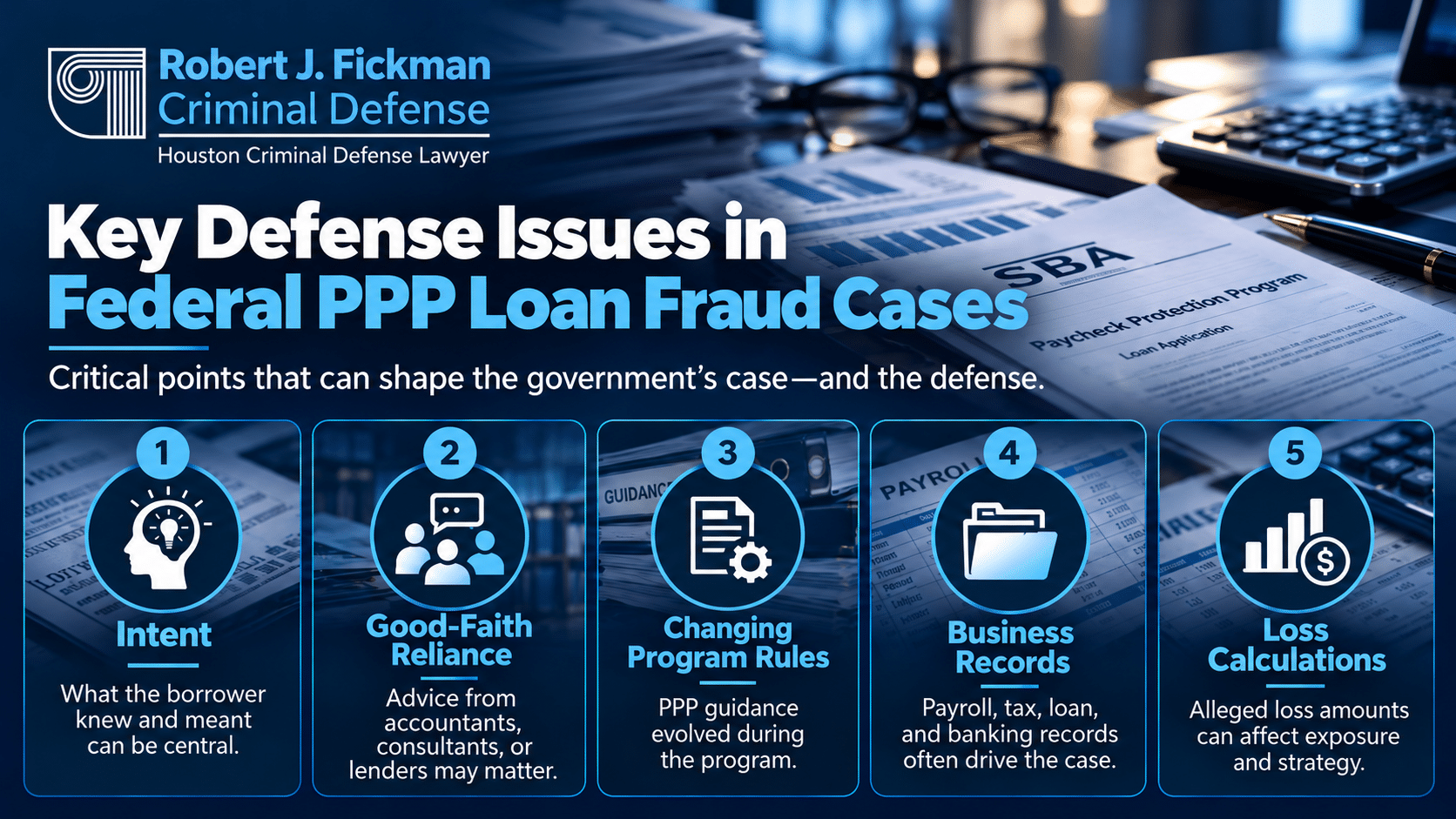
Fraud charges require proof of criminal intent. The government must prove more than a wrong number, a sloppy application, a documentation gap, or a later eligibility dispute. Prosecutors don’t need a confession because they may infer intent from the circumstances, documents, money flows, and statements made during the investigation. But lack of criminal intent remains a central defense issue.
The PPP was created quickly and revised repeatedly. Borrowers, lenders, accountants, and advisers were often applying changing rules in real time. Questions about who counted as an employee, how owner compensation was treated, whether contractor payments qualified, what expenses were authorized, and what the necessity certification required can become important defense issues.
Potential defense issues may include:
- Whether the borrower knowingly made a false statement
- Whether the borrower relied on a lender, accountant, bookkeeper, payroll provider, or adviser
- Whether the alleged error involved confusion over changing rules rather than fraud
- Whether payroll, revenue, or expense figures were supported by business records
- Whether loan proceeds were used for authorized purposes
- Whether the government can prove who prepared or submitted the application
- Whether the alleged loss calculation is accurate
- Whether forgiveness issues were administrative, civil, or criminal in nature
The difference between a careless figure and a knowingly false statement can be critical. A defense strategy should focus on the actual documents, the timeline, the borrower’s understanding, the source of the numbers, and the government’s theory of deception.
The Civil Track Running Beside the Criminal Case
Civil exposure can exist alongside criminal exposure. Under the False Claims Act, the government may seek three times its damages plus applicable civil penalties when the statutory requirements are met.
A PPP loan review, forgiveness denial, civil investigative demand, or repayment demand may be the first visible sign of a civil investigation. Statements made to a lender, the SBA, an auditor, a civil investigator, or during a forgiveness proceeding may later become relevant to a criminal investigation.
That is why a borrower should not assume a civil request is harmless or that an informal explanation cannot create additional risk. Civil resolution may be possible in some cases, but approach it carefully when criminal exposure may also exist.
Defense counsel should evaluate whether the matter is civil, criminal, or parallel; whether prosecutors are involved; and whether responding to one investigation could affect the other.
Why You Should Not Answer a Federal Loan Inquiry Alone
Many people want to explain that the loan was legitimate, the business was struggling, or someone else prepared the application. That instinct is understandable, but it can be dangerous. Early statements can lock a person into a version of events before counsel has reviewed the records.
If agents, investigators, lenders, auditors, or SBA representatives ask questions about a PPP or EIDL loan, avoid guessing, minimizing, or trying to “clear things up” on your own. Even a truthful but incomplete answer can create problems if it conflicts with bank records, payroll records, tax filings, emails, or forgiveness documents.
Before responding, preserve records and speak with counsel. Do not delete emails, discard bank records, alter payroll documents, move money to conceal it, or ask anyone else to change documents. Conduct after learning of an investigation can create separate legal exposure even when the underlying PPP allegation is disputed.
If you believe a federal investigation may already be underway, the firm’s Houston Federal Investigation FAQ explains common warning signs and what to consider before communicating with federal agents.
How a Houston Federal Fraud Lawyer Can Help
Robert J. Fickman Criminal Defense has defended clients in state and federal criminal cases for more than 40 years. In PPP, SBA, and pandemic-loan fraud matters, the defense may require detailed review of loan applications, payroll records, tax filings, bank records, forgiveness materials, communications with lenders, and the government’s claimed loss.
A Houston federal fraud lawyer may be able to:
- Review a subpoena, agent request, forgiveness denial, or loan-review notice
- Determine whether the matter appears civil, criminal, or both
- Communicate with federal agents, prosecutors, lenders, or civil investigators
- Review loan applications, forgiveness materials, and supporting records
- Evaluate intent, reliance, eligibility, and use-of-funds issues
- Assess whether the government’s loss calculation is supported
- Identify weaknesses in wire fraud, bank fraud, false-statement, conspiracy, money-laundering, or identity-theft theories
- Prepare the client before any interview or document production
- Work to address the investigation before charges are filed when possible
The defense should begin with the records, not assumptions. A PPP fraud allegation may sound simple, but the actual case may turn on who prepared the application, what the borrower understood at the time, what the lender requested, how the proceeds were used, and whether prosecutors can prove criminal intent.
Answer a Federal Loan Inquiry With Counsel in the Room
If you receive a subpoena, agent visit, loan review, civil demand, or forgiveness denial, do not respond until you understand the risk. A federal PPP loan fraud investigation can involve criminal charges, civil False Claims Act exposure, repayment demands, and long-term business consequences.
Robert J. Fickman Criminal Defense represents clients facing PPP fraud allegations, EIDL fraud allegations, bank fraud, false statements, conspiracy, identity theft, money laundering, and related white collar charges in Houston and throughout Texas.
For broader information about federal charges and investigations, visit the firm’s Houston Federal Criminal Defense FAQ.
To discuss your situation confidentially, contact Robert J. Fickman Criminal Defense before answering questions, producing documents, or speaking with agents.
Related