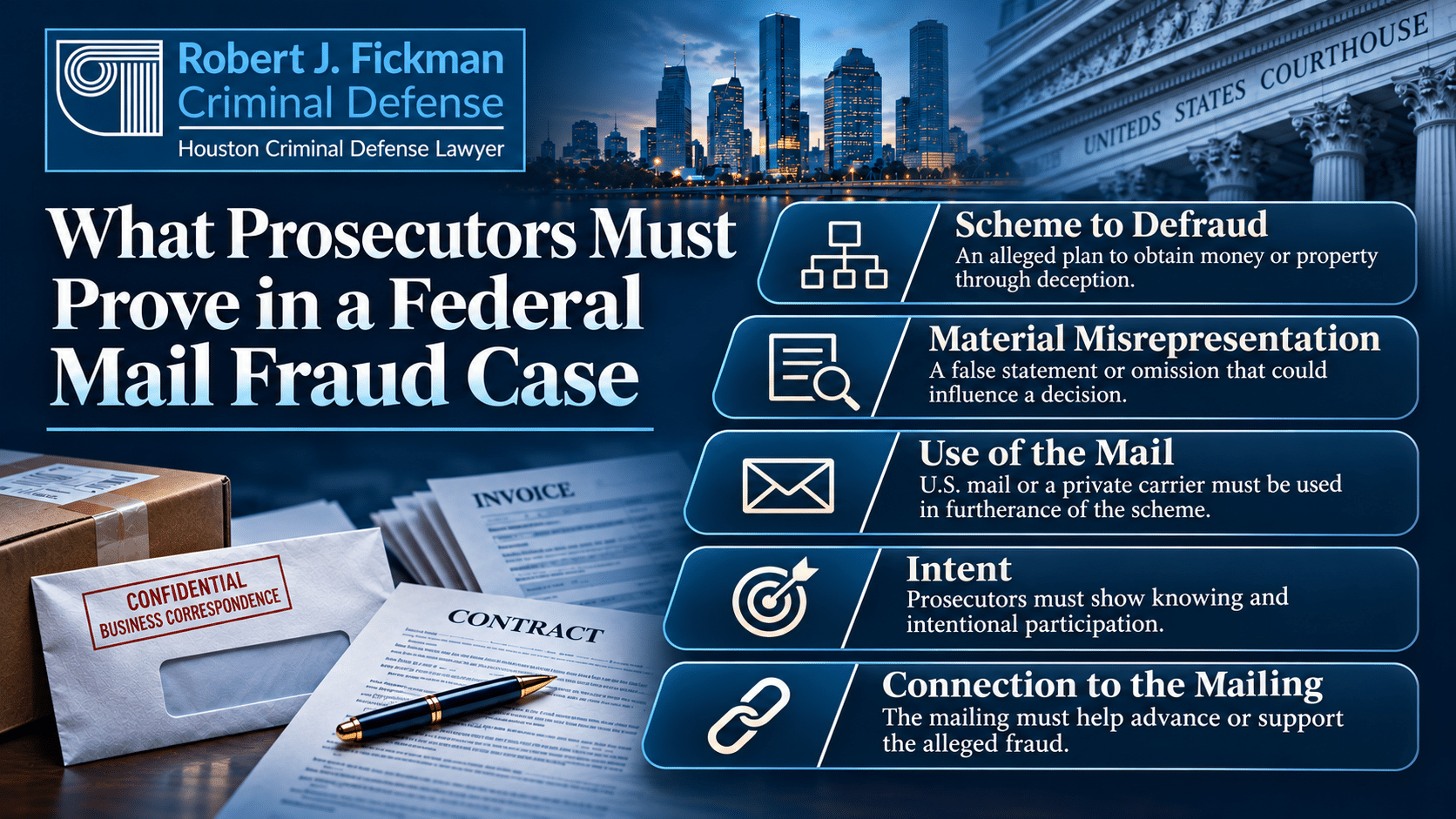
Defending against federal mail fraud charges in Texas starts with the elements prosecutors must prove. Under 18 U.S.C. § 1341, the government generally must establish a scheme to defraud or obtain money or property through materially false or fraudulent pretenses, along with a mailing or qualifying private-carrier delivery used to execute or further the scheme. Prosecutors must also prove fraudulent intent.
A standard mail fraud count carries up to 20 years in prison. The maximum increases to 30 years and a $1 million fine when the offense affects a financial institution or involves certain benefits connected to a presidentially declared major disaster or emergency. Mail fraud also frequently appears alongside wire fraud, bank fraud, health care fraud, false-statement, money-laundering, or conspiracy allegations.
Because federal fraud investigations often develop before prosecutors file an indictment, early representation can matter. Robert J. Fickman Criminal Defense represents clients facing serious federal fraud charges in Houston and can evaluate the government’s theory before a client makes statements or produces records without understanding the potential exposure. Early intervention can sometimes keep a client from being charged with a crime.
What Federal Mail Fraud Covers in Texas White-Collar Cases
Federal mail fraud covers schemes to defraud or schemes to obtain money or property through false or fraudulent pretenses when the U.S. mail or a private or commercial interstate carrier is used for the purpose of executing or attempting to execute the scheme. The mailing itself does not have to contain a false statement. The issue is whether the mailing was sufficiently connected to the alleged scheme.
A defendant also does not necessarily have to personally place an item in the mail. Federal law reaches conduct in which a person causes the mail or a qualifying carrier to be used as part of carrying out the alleged scheme. That makes the timing and purpose of each mailing important when evaluating whether the government can satisfy the jurisdictional element.
Houston federal cases are prosecuted in the Southern District of Texas. Many white-collar matters develop long before an indictment through interviews, document requests, search warrants, and grand jury subpoenas for business records. Robert Fickman’s Houston Federal Investigation FAQ explains additional warning signs that a federal investigation may already be underway.
What Prosecutors Must Prove in a Federal Mail Fraud Case
A federal mail fraud prosecution typically centers on three questions: Was there a scheme to defraud or obtain money or property by fraudulent means? Did the defendant act with the required intent to defraud? And was the mail or a qualifying private carrier used for the purpose of executing or attempting to execute the scheme? When the theory depends on a misrepresentation, materiality also matters – the alleged falsehood must be capable of influencing the decision at issue.
Those requirements create several potential defense issues. The dispute may concern what was actually represented, whether the statement was false, whether it was material, what the defendant knew at the time, whether the government can prove fraudulent intent, or whether the mailing occurred in furtherance of the alleged scheme rather than after the relevant transaction was already complete.
The Justice Department’s mail and wire fraud prosecution policy also states that federal fraud prosecutions ordinarily should not be brought when a matter consists of isolated transactions between individuals involving minor losses that are more appropriately handled through state civil or criminal proceedings. That policy does not create a defense on its own, but it can be relevant when the government tries to turn an ordinary private business dispute into a federal fraud case.
Federal Mail Fraud Penalties and the 30-Year Enhancement
Each federal mail fraud count can carry up to 20 years in prison. If the offense affects a financial institution, the statutory maximum rises to 30 years, and the maximum fine rises to $1 million. The same enhanced maximum applies when the violation involves certain benefits connected to a presidentially declared major disaster or emergency.
Related charges can materially change the overall exposure. Wire fraud generally carries the same 20-year maximum and the same 30-year enhancement when a financial institution is affected. A conspiracy charged under 18 U.S.C. § 1349 carries the same maximum punishment as the underlying fraud offense. Bank fraud can carry up to 30 years, while federal health care fraud generally carries up to 10 years, with higher penalties when serious bodily injury or death results.
The statute of limitations is another important issue. The general federal limitations period is five years, but mail or wire fraud that affects a financial institution is subject to a 10-year limitations period. The timing analysis can depend on the specific mailing or transmission charged, not simply when the broader business relationship began.
Mail Fraud Defenses Shaped by Recent Supreme Court Rulings
Recent Supreme Court decisions have continued to define the limits of federal fraud law. In Ciminelli v. United States (2023), the Court rejected the “right-to-control” theory, which treated deprivation of potentially valuable economic information as property for purposes of federal fraud. The federal fraud statutes protect traditional property interests; they do not give prosecutors a general power to criminalize every deceptive business practice.
In Kousisis v. United States (2025), the Court clarified another boundary. A fraud conviction does not require proof that the defendant intended to cause the victim a net economic loss. A material lie that induces a victim to part with money or property can still support fraud liability when money or property is an object of the scheme, even if the victim receives something of economic value in return.
Skilling v. United States (2010) separately limited federal honest-services fraud to bribery and kickback schemes. Taken together, these decisions make the alleged scheme’s precise object, the nature of the claimed property interest, and the role of the alleged misrepresentation especially important in federal mail and wire fraud cases.
For broader answers about fraud investigations, subpoenas, target and subject status, money laundering, conspiracy, and related allegations, see the firm’s Houston White-Collar Crime FAQ.
How Federal Sentencing, Restitution and Forfeiture Work in Fraud Cases
Federal fraud sentencing is individualized, but mail fraud is generally sentenced under U.S.S.G. § 2B1.1. For an offense with a statutory maximum of 20 years or more, the guideline starts with a base offense level of 7. The loss table can then substantially increase the offense level. Under the current Federal Sentencing Guidelines, loss is generally the greater of actual loss or intended loss, and additional adjustments may apply based on factors such as the number of victims, substantial financial hardship, sophisticated means, use of identification information, a leadership role, or abuse of a position of trust. Notably, courts consider these same factors in all Federal fraud case sentencings.
The loss calculation can therefore become one of the most consequential disputes in a fraud case. The U.S. Sentencing Commission reports that in fiscal year 2025, 75% of individuals sentenced for the broader category of theft, property destruction, and fraud offenses received prison, with an average sentence of 23 months. Those figures are not mail-fraud-specific and do not predict an individual sentence, but the Commission’s federal fraud sentencing data illustrates the importance of guideline calculations.
Restitution may also be mandatory in a federal fraud case when an identifiable victim suffered a qualifying pecuniary loss. The government may also pursue forfeiture of property or proceeds tied to the offense. Restitution, forfeiture, and guideline loss are related concepts, but they are not necessarily calculated the same way.
What a Defense Lawyer Reviews in a Federal Mail Fraud Case
A mail fraud defense should start with the actual communications, contracts, records, payments, and mailings, not the government’s summary of the alleged scheme. A defense lawyer may examine who made each statement, what the speaker knew at the time, whether the statement was actually false, whether it was material, and whether the government can prove an intent to defraud rather than a mistake, misunderstanding, failed business judgment, or contractual dispute.
The mailing element deserves separate attention. Counsel may review who sent the item, why it was sent, whether use of the mail or carrier was reasonably connected to the alleged scheme, and whether the mailing occurred before or after the transaction the government says was fraudulent. In a multi-count case, evaluate each alleged mailing or transmission rather than treating all counts as interchangeable.
Defense counsel may also challenge the government’s loss calculation, identify legitimate value provided to an alleged victim, evaluate restitution and forfeiture claims, and determine whether related wire fraud, bank fraud, conspiracy, or money-laundering counts add elements the government cannot prove.
Confront Federal Mail Fraud Charges With a Houston Federal Fraud Lawyer
Robert J. Fickman Criminal Defense represents clients in federal matters from the investigation stage through indictment and trial. Early review is especially important when federal agents request an interview, a subpoena is issued, or prosecutors are still deciding whether to seek charges.
If you have received a target letter, grand jury subpoena, search warrant, or contact from federal agents, review the situation with counsel before making substantive statements. Robert Fickman’s Houston Federal Grand Jury Subpoena FAQ and Houston Federal Criminal Defense FAQ provide additional information about the federal process.
Case evaluations are free, and the firm is available 24/7. Contact Robert J. Fickman Criminal Defense to discuss federal mail fraud allegations or an ongoing white-collar investigation in Houston or elsewhere in Texas.
Related