A missed loan payment, a failed business deal, a soured partnership, or a bitter divorce may start as a civil dispute. In Texas, however, the same facts that support a civil lawsuit can sometimes lead to a criminal investigation.
That shift often happens when one side claims the other did more than break a promise. A former business partner may claim money was diverted. An investor may claim they were misled. An estranged spouse may claim assets were hidden or moved. A lender or vendor may claim a debt was really theft. What begins as a dispute over money, contracts, ownership, or accounting can eventually involve detectives, subpoenas, a grand jury, or even a felony indictment.
For business owners, professionals, executives, and individuals in Houston, the key issue is often timing. By the time law enforcement is called, investigators may already have documents, emails, bank records, witness statements, and a version of events provided by the complaining witness.
Robert J. Fickman Criminal Defense represents individuals and businesses facing serious fraud, financial crime, and white collar crime allegations in Houston and throughout Texas. If a civil dispute may be turning into a criminal matter, early involvement of defense counsel can make a significant difference.
How a Civil Dispute Can Turn into a Criminal Investigation
Most financial disputes are resolved in civil court. Civil cases usually focus on whether someone breached a contract, failed to repay money, violated a business agreement, mishandled company funds, or caused financial damages. The typical remedy is monetary compensation, not jail or prison.
A civil dispute can become criminal when the accusation shifts from “you owe me money” to “you stole from me,” “you lied to get money,” “you diverted funds,” or “you intended to deceive me.” In a Texas theft case, prosecutors must generally prove unlawful appropriation of property with intent to deprive the owner of that property. That intent issue is often what separates a business loss from a criminal allegation. Texas Penal Code § 31.03 defines theft as unlawful appropriation with intent to deprive.
The people who bring these allegations to law enforcement often include:
- An unpaid vendor or lender who believes a debt was really a theft.
- A spouse who claims assets were hidden, moved, or misrepresented during a divorce.
- A business partner who says money was diverted from the company.
- An investor who lost money and suspects fraud.
- An employer who believes an employee misused company funds.
- A client or customer who believes they were misled about how money would be used.
Police and prosecutors are not required to adopt the complaining witness’s version of events. Still, a motivated complainant with documents, bank records, emails, and a lawyer can influence how the case is presented at the beginning. That early framing can matter.
Civil Liability Is Not the Same as Criminal Intent
A failed deal does not automatically mean a crime occurred. Businesses fail. Investments lose money. Contracts are broken. Partners disagree over authority, compensation, distributions, expenses, and ownership. None of that automatically proves theft or fraud.
The criminal issue is usually intent.
A breach of contract case asks whether a legal promise was broken. A fraud, theft, or misapplication case asks whether the person acted with criminal intent, deception, or unlawful purpose. That difference is important because honest business mistakes, poor judgment, cash flow problems, accounting errors, and unexpected losses can occur without criminal intent.
In many white collar defense cases, the most important evidence is not just the amount of money involved. It is the paper trail showing what the person believed, what was disclosed, who approved the transaction, how funds were documented, and whether the conduct was consistent with a business arrangement rather than a criminal plan.
Relevant evidence may include:
- Contracts and operating agreements.
- Partnership records.
- Loan documents.
- Invoices and payment records.
- Bank statements.
- Emails and text messages.
- Accounting entries.
- Board or member approvals.
- Prior course of dealing between the parties.
- Tax records and financial statements.
The same documents used to defend a civil claim may also help show that the dispute should not be treated as a criminal case.
Common White Collar Allegations in Texas Business Disputes
Texas does not have one single “white collar crime” statute. Instead, prosecutors may use several different offenses depending on the facts, the dollar amount, the relationship between the parties, and the type of property or transaction involved.
Common allegations include:
Theft. Texas theft law is based largely on the value of the property involved. Theft of $2,500 or more can be charged as a felony, and theft of $300,000 or more can reach first-degree felony exposure. Texas Penal Code § 31.03 sets out the value-based punishment structure.
Misapplication of fiduciary property. This charge may arise when someone accused of acting in a fiduciary capacity allegedly misapplies property in a way that creates a substantial risk of loss. It can involve trustees, executors, administrators, agents, managers, employees who carry out fiduciary functions, or others accused of improperly handling entrusted funds. Texas Penal Code § 32.45 addresses misapplication of fiduciary property.
Money laundering. Money laundering allegations may arise when the government claims funds were connected to criminal activity and were moved, concealed, or handled in a way that violates state or federal law. Texas money laundering law is addressed in Texas Penal Code Chapter 34.
Forgery, credit card abuse, and financial-document offenses. These allegations may involve signatures, checks, account documents, loan paperwork, applications, billing records, or other financial documents.
Securities fraud or investor fraud. These cases may involve claims that investors were misled about risk, use of funds, business performance, ownership, or expected returns.
Federal fraud allegations. If the dispute involves interstate communications, banks, healthcare programs, government funds, wire transfers, or federal agencies, federal exposure may become part of the case. The FBI describes white collar crime as financially motivated, non-violent crime that can involve regional, national, or international investigations.
One disputed transaction can lead to more than one charge. The number of counts, the alleged dollar amount, and whether the case is handled in state or federal court can significantly affect the risk.
When a Business Debt Becomes a Criminal Charge
Debt alone is not supposed to be a crime. A person may owe money, fail to repay a loan, miss a payment to a vendor, or default under a contract without committing theft or fraud.
The risk increases when the complaining witness claims the person never intended to repay, lied about how money would be used, diverted funds for an unauthorized purpose, concealed assets, falsified documents, or took property that belonged to someone else.
That is why timing matters. Payments made late may look different when supported by emails showing ongoing negotiations. A disputed transfer may look different when company records show approval. A failed investment may look different when the investor signed documents acknowledging risk. A business expense may look different depending on how accounting records categorize and disclose the funds.
Early legal review can help identify the documents that tell the full story before investigators see only the complainant’s version.
Parallel Civil and Criminal Cases
Civil and criminal cases sometimes move forward at the same time. This creates serious risk.
A person sued in civil court may be asked to answer written discovery, produce documents, sit for a deposition, or testify under oath. At the same time, law enforcement may be investigating the same transactions. Statements made in the civil case can later be used in a criminal investigation or prosecution.
The Fifth Amendment protects against compelled self-incrimination. But invoking the Fifth Amendment in a civil case can have consequences in that civil case. Courts may allow adverse inferences in certain civil settings, creating tension between defending a civil lawsuit and avoiding statements that could create criminal exposure. See Baxter v. Palmigiano.
That is one reason people involved in financial disputes should speak with a criminal defense attorney before giving sworn testimony, producing sensitive records, or making statements to investigators. The civil lawyer and criminal defense lawyer may need to coordinate strategy so that one case does not damage the other.
When a State Dispute Creates Federal Exposure
Some disputes begin locally but attract federal attention. That can happen when the alleged conduct involves banks, wire transfers, interstate communications, federal funds, healthcare programs, tax issues, securities, or conduct crossing state lines.
Federal white-collar investigations can involve the FBI, the IRS Criminal Investigation, the Department of Justice, the U.S. Attorney’s Office, bank fraud investigators, or other federal agencies. The Department of Justice identifies white-collar and corporate enforcement as part of its criminal enforcement work, including fraud, money laundering, and other financial crimes.
Federal exposure can change the entire posture of the case. Federal investigators may use subpoenas, grand jury proceedings, search warrants, interviews, bank records, forensic accounting, and digital evidence. Grand jury proceedings in the Texas and federal systems also differ from ordinary civil litigation. Texas grand jury proceedings are secret under state law, and subpoenas or summonses related to a grand jury investigation may also be kept secret when necessary.
If there is any sign that a civil dispute is becoming a federal investigation, it is important to get legal guidance before speaking with agents, producing documents informally, or assuming the issue is still “just a lawsuit.” For more information about federal investigations, see Robert J. Fickman’s page on what to do if you think you may be under federal criminal investigation.
Warning Signs That a Civil Dispute May Be Turning Criminal
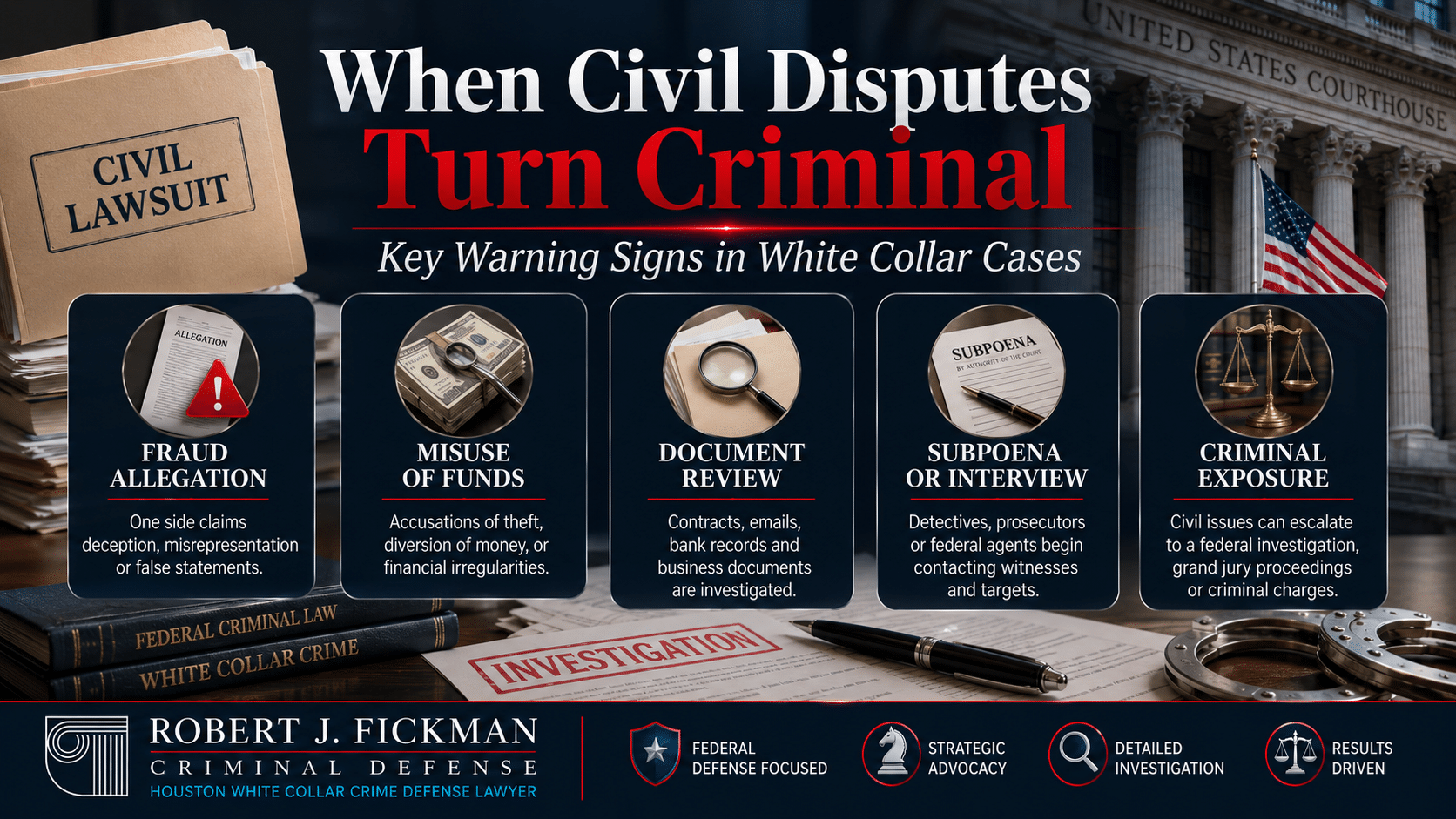
A civil dispute may require criminal defense attention when:
- The other side threatens to “press charges.”
- A police detective contacts you.
- A prosecutor, investigator, or federal agent asks for an interview.
- You receive a subpoena for financial records.
- A bank freezes or flags an account.
- Your employer, partner, spouse, or investor accuses you of theft or fraud.
- You are asked to explain transactions without counsel present.
- A civil deposition will cover the same facts that could support a criminal allegation.
- A grand jury subpoena appears.
- You learn that the FBI, IRS, or another federal agency is involved.
These warning signs do not mean charges are guaranteed. They do mean the situation should be handled carefully.
How a White Collar Defense Lawyer Can Help Early
Early defense work can affect how the facts are understood before the case hardens into a criminal charge. In some cases, the defense may be able to show prosecutors or investigators that the matter is a civil dispute, an accounting disagreement, a contract issue, or a business failure rather than a crime.
A white collar defense lawyer may help by:
- Reviewing the civil pleadings, demand letters, and business records.
- Identifying criminal exposure before statements are made.
- Coordinating with civil counsel.
- Protecting Fifth Amendment issues.
- Preparing for subpoenas or document demands.
- Reviewing emails, accounting records, and bank records.
- Presenting context to investigators or prosecutors when appropriate.
- Challenging the complainant’s version of events.
- Explaining the difference between breach of contract and criminal intent.
- Protecting the client before an interview, deposition, or grand jury issue develops.
For related federal matters, Robert J. Fickman also represents clients facing federal fraud allegations, federal bank fraud charges, and broader federal criminal defense issues.
Contact a Houston White Collar Crime Lawyer
A civil claim and a criminal investigation can grow from the same facts. The sooner criminal exposure is recognized, the more room there may be to protect the client, preserve helpful records, coordinate the civil and criminal strategy, and challenge the accusation before it becomes an indictment.
If you are involved in a business dispute, partnership conflict, divorce-related financial dispute, investor disagreement, or debt claim that may be turning into a criminal investigation, Robert J. Fickman Criminal Defense can review the situation with you.
To discuss your case confidentially, contact Robert J. Fickman Criminal Defense.
Frequently Asked Questions
Can a civil dispute become a criminal case in Texas?
Yes. A civil dispute can become a criminal case if someone alleges theft, fraud, misapplication of funds, forgery, money laundering, or another criminal offense. The key issue is usually whether the government believes there is evidence of criminal intent, not merely whether money is owed.
Is breach of contract a crime in Texas?
Usually, no. Breach of contract is generally a civil issue. It may become a criminal concern if the accusation involves intent to deceive, intent to deprive someone of property, the use of false documents, the concealment of assets, or the misuse of entrusted funds.
Should I speak to police if a business partner accuses me of theft?
You should speak with a criminal defense lawyer before talking to police, prosecutors, federal agents, or investigators. Even if you believe the dispute is civil, statements made early can be used later if the matter becomes a criminal case.
Related