When a person is charged with a federal crime in Texas, prior criminal history can become one of the most important issues in the case. A prior state conviction may affect the advisory guideline range, the defendant’s criminal history category, plea negotiations, statutory enhancements, and the sentence a federal judge ultimately imposes.
This is true even when the earlier case was handled in state court, involved probation, resulted in a relatively short jail sentence, or happened years before the current federal charge. In some cases, a prior Texas conviction or deferred adjudication may have consequences in federal court that are not apparent from how federal and state criminal cases are handled.
For more than four decades, Houston federal criminal defense lawyer Robert J. Fickman has represented clients in serious federal criminal matters in Houston and throughout Texas. If you are facing a federal charge and have a prior Texas criminal history, it is important to understand how that history may be evaluated before sentencing.
Why Prior State Convictions Matter in Federal Sentencing
Federal sentencing is driven by more than the charge itself. After a conviction or guilty plea, the court considers the federal sentencing guidelines, statutory penalties, the facts of the offense, the defendant’s background, and the arguments presented by the prosecution and defense.
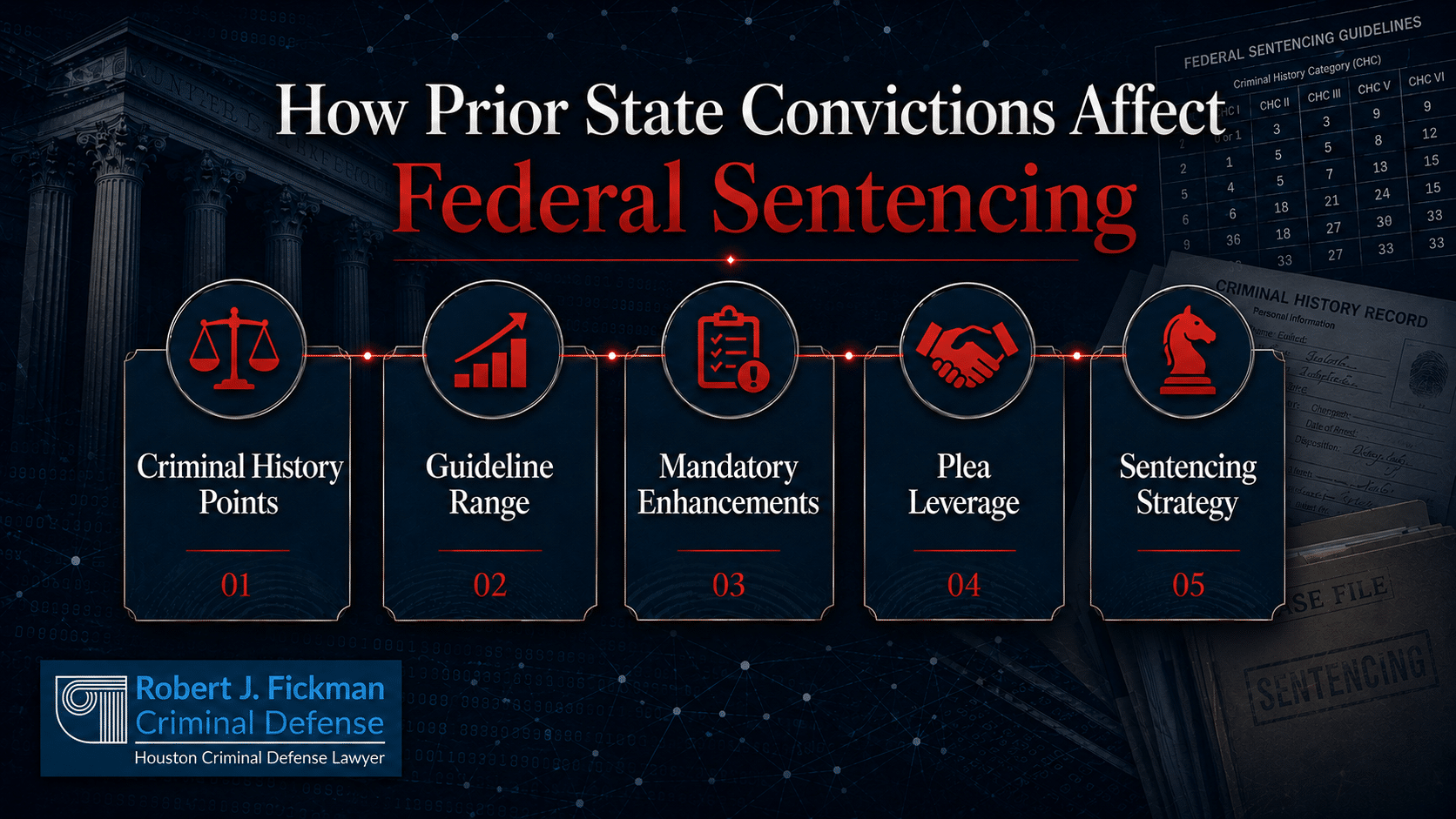
Prior state convictions can matter in several ways:
- They may add criminal history points.
- They may move a defendant into a higher criminal history category.
- They may increase the advisory guideline range.
- They may affect whether a defendant qualifies for certain forms of relief.
- They may trigger statutory enhancements in firearm, drug, immigration, and other federal cases.
- They may influence how the prosecutor, probation officer, and judge view the defendant’s history.
The practical effect can be significant. A person with the same federal charge and the same alleged conduct may face a very different sentencing range depending on how prior state cases are counted.
How the Federal Sentencing Guidelines Use Criminal History
The Federal Sentencing Guidelines use a sentencing table that considers two major factors: the seriousness of the current federal offense and the defendant’s criminal history category. The offense level appears on one axis, and the criminal history category appears on the other.
Criminal history categories range from Category I to Category VI. Category I generally applies to defendants with little or no record of criminal convictions. Category VI applies to defendants with the highest number of criminal history points.
A prior Texas misdemeanor or felony conviction may increase the criminal history score if it qualifies as a prior sentence under the federal guidelines. That increase can raise the guideline range and create a more serious sentencing posture.
The current federal guideline rules assign criminal history points based mainly on the length and nature of the prior sentence. Under U.S.S.G. §4A1.1:
- Three points are added for each prior sentence of imprisonment exceeding one year and one month.
- Two points are added for each prior sentence of imprisonment of at least 60 days that is not otherwise counted under the three-point rule.
- One point is added for certain other prior sentences, subject to guideline limits.
- One additional point may be added if the defendant already has 7 or more criminal history points and committed the federal offense while under a criminal justice sentence, such as probation, parole, supervised release, imprisonment, work release, or escape status.
That last point is especially important because the rule changed. Older references to automatic two-point “status points” are no longer accurate under the current guideline structure.
Which Texas Convictions May Count in Federal Court?
Federal courts do not ignore a conviction simply because it was entered in a Texas state court. State convictions are often counted when calculating federal criminal history.
However, the analysis is not always simple. A federal defense lawyer may need to examine:
- The date of the prior sentence.
- The sentence that was actually imposed.
- Whether the defendant served jail or prison time.
- Whether the sentence was suspended.
- Whether probation was imposed.
- Whether the case involved deferred adjudication.
- Whether multiple prior cases are counted separately or treated as related.
- Whether the prior conviction has been expunged, set aside, pardoned, or otherwise affected by later court action.
- Whether the prior offense qualifies under a specific federal enhancement statute.
Timing matters. Under U.S.S.G. §4A1.2, prior sentences of imprisonment exceeding one year and one month are generally counted if the sentence was imposed within 15 years of the commencement of the current federal offense, or if the defendant’s incarceration extended into that 15-year period. Other prior sentences are generally counted if imposed within 10 years of the current federal offense.
That distinction matters because an older Texas conviction may still count in federal court if the sentence was long enough or if the defendant remained incarcerated within the relevant guideline period.
Texas Deferred Adjudication and Federal Sentencing
Texas deferred adjudication can create confusion in federal sentencing. In Texas, a person who successfully completes deferred adjudication may not have a final conviction entered in the same way as a traditional conviction. But federal courts may still treat deferred adjudication as relevant for sentencing purposes in certain situations.
That does not mean every deferred adjudication automatically has the same effect in every federal case. The outcome may depend on the guideline provision, the statute at issue, the nature of the prior offense, the procedural history of the state case, and how federal law defines the issue.
For that reason, deferred adjudication should not be brushed aside as “not a conviction” without a careful federal sentencing analysis. What matters in state court and what matters in federal court are not always the same.
A federal defense lawyer may challenge how a prior Texas deferred adjudication is characterized, whether it qualifies under the applicable guideline, whether it can support a statutory enhancement, and whether the government has satisfied the procedural requirements needed to rely on it.
Mandatory Enhancements Based on Prior Convictions
Criminal history points are not the only concern. In some federal cases, prior convictions may trigger mandatory statutory enhancements that are separate from the advisory guideline range.
One major example is the Armed Career Criminal Act, often called ACCA. Under 18 U.S.C. § 924(e), a person convicted of unlawful firearm possession under § 922(g) may face a 15-year mandatory minimum if they have three qualifying prior convictions for violent felonies or serious drug offenses committed on different occasions.
Prior convictions may also affect federal sentencing enhancements, especially in firearm cases where the government argues that earlier convictions qualify as predicate offenses.
Prior convictions can also matter in federal drug offenses. Under federal law, certain prior drug convictions may increase statutory penalties, but the government must follow specific notice procedures before seeking an increased sentence based on those prior convictions. In drug cases, this is commonly handled through an information filed under 21 U.S.C. § 851.
These enhancements are not automatic in the sense that they should never be challenged. A defense lawyer may examine whether the prior conviction legally qualifies, whether the statute matches the federal definition, whether the prior offenses were committed on different occasions, whether the government gave proper notice, and whether the prior conviction is constitutionally or procedurally vulnerable.
How Prior Convictions Can Be Challenged at Federal Sentencing
Prior convictions used in federal sentencing are not always beyond dispute. Depending on the case, the defense may be able to challenge the government’s or probation office’s treatment of prior convictions.
Common issues include:
- Whether the prior sentence is too old to count under the guidelines.
- Whether the sentence length was calculated correctly.
- Whether multiple prior cases should be treated separately.
- Whether the prior offense qualifies as a violent felony, crime of violence, serious drug offense, controlled substance offense, or other predicate offense.
- Whether a Texas deferred adjudication is being used properly.
- Whether the government filed the required notice for a statutory enhancement.
- Whether the prior conviction was expunged, set aside, pardoned, or otherwise invalid for federal sentencing purposes.
- Whether the presentence report accurately describes the prior case.
These issues often arise after the presentence investigation report is prepared. At that point, the defense may need to file objections, submit sentencing evidence, negotiate with the government, and present legal arguments to the court.
The earlier these issues are identified, the more time the defense has to obtain records, review plea documents, analyze state statutes, and prepare objections.
Why Early Federal Defense Representation Matters
Federal sentencing can be highly technical. A defendant’s prior Texas record may affect far more than the final sentencing hearing. It may shape the government’s plea offer, the defense strategy, the guideline calculations, and the risks associated with going to trial or entering a plea.
Early involvement of defense counsel allows an attorney to review the prior record before the case reaches sentencing. That review may include obtaining state court judgments, plea paperwork, probation records, jail records, charging documents, and other materials needed to determine whether a prior conviction has been counted correctly.
For defendants with prior Texas convictions, this analysis should begin as early as possible. Waiting until sentencing may limit the time available to investigate and challenge criminal history issues.
For broader answers about federal charges, investigations, indictments, and defense strategy, visit the firm’s federal criminal defense FAQ.

Contact Robert J. Fickman Criminal Defense in Houston
If you are facing federal criminal charges in Houston or anywhere in Texas, and you have prior state convictions that may affect your sentence, you should speak with an experienced federal criminal defense lawyer as soon as possible.
Prior convictions can change the guideline range, trigger enhancement issues, and affect the entire defense strategy. They may also be subject to challenge if they are being counted incorrectly or used improperly.
Robert J. Fickman Criminal Defense represents clients in serious federal criminal cases in Houston and throughout Texas. To discuss your situation confidentially, contact Robert J. Fickman Criminal Defense today.
Related