Federal structuring charges can arise when someone breaks up cash deposits, withdrawals, purchases, or other transactions to avoid a federal reporting requirement. Banks generally must file a Currency Transaction Report when currency transactions by or on behalf of the same person total more than $10,000 in one business day. Businesses have a separate reporting obligation when they receive more than $10,000 in cash in one transaction or related transactions. You can be charged with structuring even if the money came from a lawful source.
The critical issue is not simply whether transactions were under $10,000. Federal law focuses on whether you arranged the transactions to evade a reporting requirement. Structuring allegations can also appear alongside money laundering, bank fraud, false statements, tax offenses, or other white-collar criminal allegations.
Many people first learn of a potential structuring investigation through a call or visit from federal agents, a seizure notice, a subpoena, or a target letter. Before answering substantive questions, it is important to understand why the government is making contact and what records it may already have. Criminal Defense Attorney Robert Fickman’s Houston Federal Investigation FAQ explains how federal investigations can develop before charges are filed.
How Federal Cash Reporting Rules Apply to Texas Banks and Businesses
Federal cash-reporting rules operate differently for financial institutions and ordinary businesses. Banks must file a Currency Transaction Report for reportable transactions in currency that total more than $10,000 during a single business day. When a bank knows multiple same-day transactions are by or on behalf of the same person, it aggregates the transactions. For CTR purposes, a bank’s domestic branches are treated as one financial institution.
Businesses have a parallel reporting duty under the IRS cash payment reporting rule. A trade or business that receives more than $10,000 in cash in a single transaction or related transactions generally must file Form 8300 within 15 days. Transactions can be related even when they occur more than 24 hours apart if the business knows or has reason to know that they are part of a connected series.
These rules are reporting requirements; they do not make every cash transaction suspicious or illegal. The criminal issue arises when the government alleges that a person intentionally arranged transactions to prevent a required report from being filed.
What Counts as Structuring Under Federal Law
Under 31 U.S.C. § 5324, structuring generally means arranging transactions for the purpose of evading a federal reporting or recordkeeping requirement. Federal currency transaction reporting guidance has long warned that breaking up transactions to evade reporting can be a crime.
Conduct that may draw scrutiny includes:
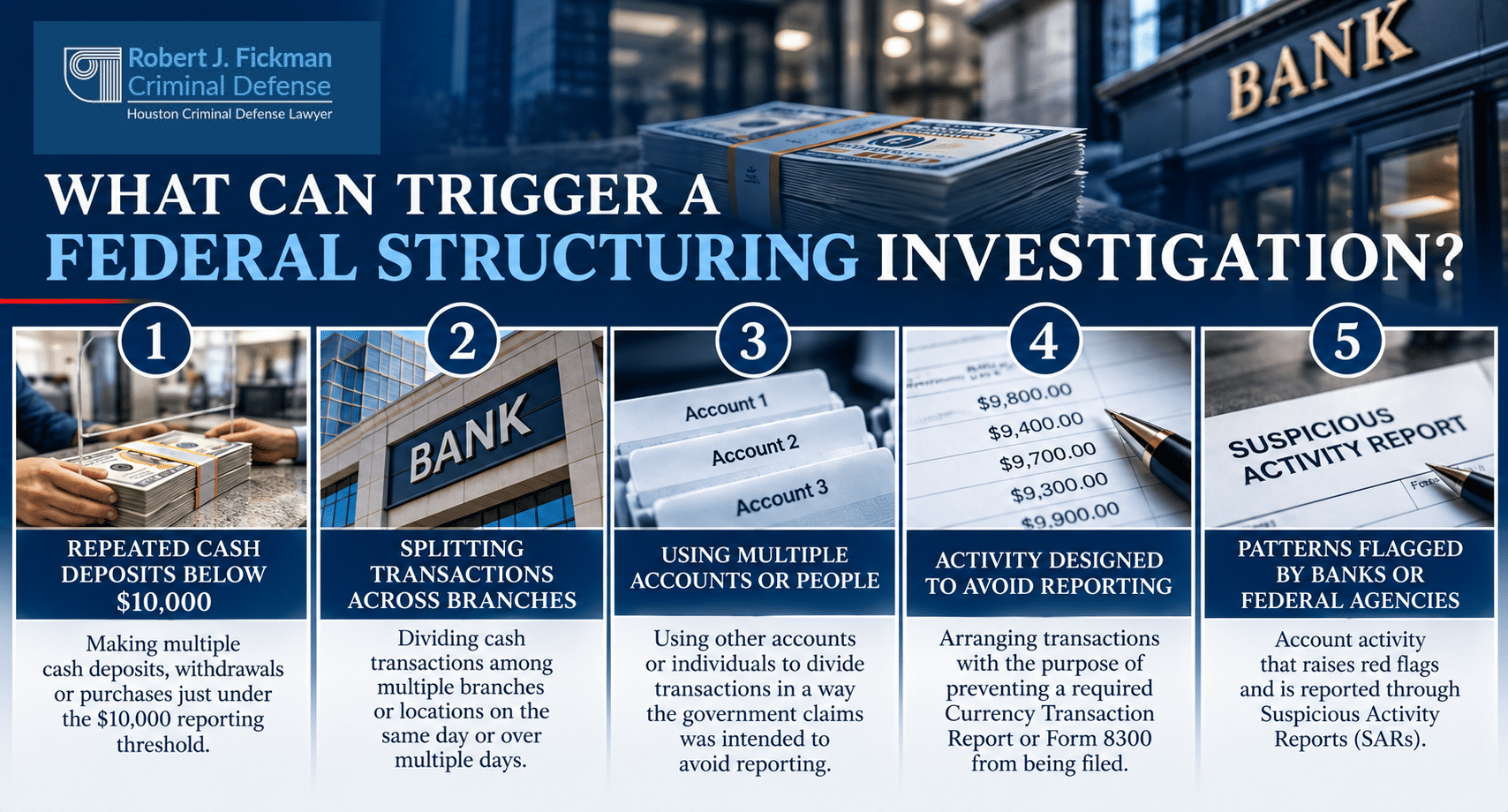
- Making a series of cash deposits or withdrawals below the reporting threshold over multiple days.
- Splitting cash among several branches or multiple transactions on the same day.
- Using other people or accounts to divide transactions in a way the government claims was intended to avoid reporting.
- Causing or attempting to cause a bank or business not to file a required report, or to file a report containing materially false information.
The key element is purpose. A pattern of transactions under $10,000 is not automatically structuring. Prosecutors must prove that the transactions were arranged to evade a reporting requirement. They do not, however, have to prove that the underlying money came from criminal activity.
The knowledge requirement has an important history. In Ratzlaf v. United States, the Supreme Court held in 1994 that the statute then in effect required proof that a defendant knew structuring was unlawful. Congress amended the law later that year, and the current statute does not require the government to prove that same knowledge-of-illegality element. The focus now is whether the person acted to evade the reporting requirement.
Federal Structuring Penalties and Forfeiture in Texas
Violating the federal structuring statute generally carries up to five years in prison, a fine, or both. The maximum increases to 10 years, with an enhanced fine, when the structuring occurs while the defendant is violating another federal law or as part of a pattern of illegal activity involving more than $100,000 in a 12-month period.
Forfeiture can be just as significant as the criminal penalties. After a structuring conviction, federal law requires forfeiture of property involved in the offense and property traceable to it. Civil forfeiture may also arise before a criminal case is resolved.
The Taxpayer First Act added special limits on IRS seizures based on alleged structuring. The IRS may seize property on that basis only when the property came from an illegal source or the transactions were structured to conceal another criminal-law violation. The IRS must generally provide notice within 30 days after seizure. An owner who requests a post-seizure hearing within 30 days after that notice may obtain prompt judicial review of whether the government has probable cause to keep the property.
How Texas Banks Flag Possible Structuring
Banks do more than file CTRs. They also monitor account activity for patterns that may indicate structuring or other suspicious conduct. Under federal Suspicious Activity Report rules, a bank generally must file a SAR when a transaction or pattern involves at least $5,000, and the bank knows, suspects, or has reason to suspect that it is designed to evade a Bank Secrecy Act requirement.
FinCEN generally requires a bank to file a SAR within 30 calendar days after initially detecting facts that may require reporting. A bank is also prohibited from telling the customer that it filed a SAR. That confidentiality can make these investigations feel sudden: an account holder may see an account restriction, receive a federal inquiry, or learn of a seizure without knowing what reporting or review occurred beforehand.
Other Federal Financial Charges That Can Accompany Structuring
Federal structuring investigations often expand beyond the cash-reporting issue. Depending on the evidence, prosecutors may examine whether the same transactions support allegations involving money laundering, bank fraud, false statements, tax offenses, conspiracy, or other financial crimes.
Money laundering under 18 U.S.C. § 1956 can carry up to 20 years in prison, while engaging in certain monetary transactions involving more than $10,000 in criminally derived property under 18 U.S.C. § 1957 can carry up to 10 years. In larger cases involving an alleged criminal enterprise, money laundering can also serve as a predicate for federal RICO charges.
Bank fraud can carry up to 30 years, and false statements to federal investigators and tax-evasion charges can each carry substantial prison exposure. The same bank records may therefore become evidence in several different charging theories.
For broader answers about fraud investigations, subpoenas, target and subject status, money laundering, conspiracy, and related federal allegations, see the firm’s Houston White-Collar Crime FAQ.
What a Defense Lawyer Reviews in a Federal Structuring Case
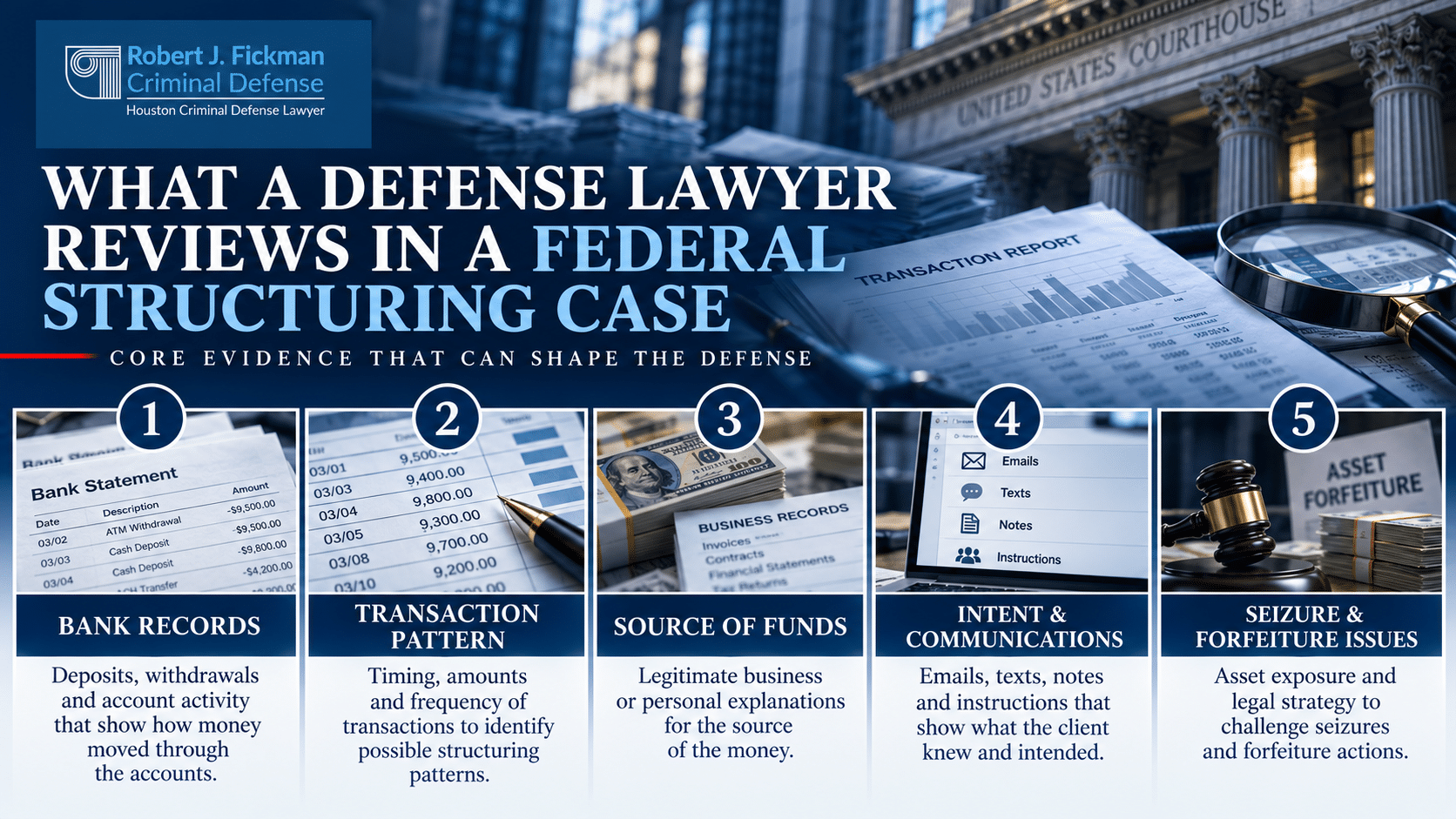
A structuring defense should start with the actual transaction history, not the government’s description of the pattern. The timing, amount, location, source, and purpose of each transaction can matter. Ordinary business practices, cash-flow needs, deposit limits, accounting procedures, advice from bank personnel, and communications showing why the transactions occurred can also matter.
The defense may also examine whether the government can prove the required purpose to evade reporting, whether agents correctly interpreted the account activity, whether statements were obtained lawfully, and whether a seizure complied with federal forfeiture procedures. In some cases, what appears suspicious as a spreadsheet pattern has a legitimate explanation when you review the underlying business records.
Respond to a Federal Structuring Investigation With a Houston Federal Criminal Defense Lawyer
Robert J. Fickman Criminal Defense can review bank records, seizure notices, subpoenas, and the timing and purpose of the transactions the government is examining. That review can help determine whether prosecutors can prove the intent required for a structuring charge and whether related financial allegations or forfeiture issues are developing.
Robert J. Fickman has more than 40 years of criminal defense experience and has served as President of the Harris County Criminal Lawyers Association. He represents clients in serious state and federal criminal matters in Houston and throughout Texas.
If federal agents have contacted you, a subpoena or target letter has arrived, or money has been seized, don’t guess what the government is investigating. Contact Criminal Defense Lawyer Robert Fickman before answering substantive questions. Free consultations are available 24/7.
Related