If federal agents have contacted you about a computer case, the investigation has likely been running for some time. These matters often arrive with digital evidence, records, subpoenas, interviews, server logs, account histories, and a theory of unauthorized access already in place. That is why what happens in the first few weeks often matters more than people expect.
Robert J. Fickman Criminal Defense represents individuals, professionals, executives, employees, business owners, and companies facing federal criminal defense matters in Houston and throughout Texas. In computer fraud and cybercrime cases, early defense work can help identify whether the government can prove unauthorized access, whether the loss figure is inflated, and whether the conduct belongs in federal court at all.
Federal computer cases are not limited to stereotypical hacking allegations. They can involve employee access disputes, business data conflicts, alleged credential misuse, cloud accounts, email systems, financial platforms, customer databases, healthcare records, trade secrets, or online conduct tied to a broader federal fraud investigation. A case that starts as an internal company issue, contract dispute, or data-access concern can become a serious federal investigation.
What Makes a Computer Case Federal Instead of a Texas State Charge?
A computer case may become federal when the system involved qualifies as a protected computer under the federal Computer Fraud and Abuse Act. Federal law defines a protected computer broadly to include computers used by or for financial institutions or the United States Government, as well as computers used in or affecting interstate or foreign commerce or communication. In practical terms, that can reach many internet-connected devices, business networks, cloud systems, servers, and online accounts.
That broad federal reach is one reason matters that feel local can end up in Federal District Court in the Southern District of Texas. A Houston-based employee, business owner, contractor, or professional may be investigated federally if the alleged access involved a protected computer, interstate communications, financial systems, government systems, or online accounts crossing state lines.
Texas also has its own computer crime statute. Texas Penal Code Chapter 33 includes breach of computer security, which generally concerns knowingly accessing a computer, computer network, or computer system without the owner’s effective consent. State and federal authorities may both have an interest in the same conduct, and the charging path is not always clear at the beginning.
That uncertainty has practical consequences. A statement given to one agency may not stay with that agency. Informal documents may later be used in a federal case. Decisions made before charges exist can shape what prosecutors, agents, and the grand jury do later.
What the Federal Computer Fraud Law Covers
The main federal computer fraud law is 18 U.S.C. § 1030, often called the Computer Fraud and Abuse Act. The statute covers several categories of conduct, including certain unauthorized access, exceeding authorized access, fraud involving protected computers, damage to protected computers, trafficking in passwords or similar access information, and extortion threats involving computers.
In many defense cases, the key questions are not simply whether a computer was accessed. More important questions often include who accessed it, whether the person had authorization, what that authorization allowed, whether any access limits were clearly established, what data was obtained or altered, and whether the government can connect a specific person to specific conduct.
Computer fraud charges can overlap with other federal allegations, including wire fraud, identity theft, trade secret theft, healthcare fraud, bank fraud, money laundering, and conspiracy. In those cases, the computer-access allegation may be one piece of a larger white collar crime investigation. For clients facing broader exposure, Robert J. Fickman Criminal Defense also handles white collar crime investigations and complex federal fraud matters.
What Exceeding Authorized Access Means After Van Buren
The phrase “exceeds authorized access” has been one of the most heavily litigated issues in federal computer fraud law. In Van Buren v. United States, the United States Supreme Court narrowed how that phrase applies. The Court held that a person exceeds authorized access when they have access to a computer but obtains information from areas of the computer, such as files, folders, or databases, that are off limits to them.
That distinction matters. Accessing information a person was entitled to see, even for an improper purpose, is different from entering a part of the system the person was not allowed to access. The issue is often whether the person crossed a clear access boundary, not simply whether the employer, company, or system owner disapproved of the reason for access.
This can be especially important in employee, contractor, vendor, and business-partner disputes. A person may have had credentials, account permissions, database access, or administrative privileges. The defense may need to examine what those permissions actually allowed, whether access was revoked, whether the person knew of any restriction, and whether the government’s theory fits the narrower reading of the law.
How DOJ Policy Limits Some Federal Computer Fraud Charges
Federal prosecutors also work under a Department of Justice charging policy for Computer Fraud and Abuse Act cases. The DOJ Justice Manual states that prosecutors should not bring certain exceeding-authorized-access charges based only on contract terms, terms of service, employee policies, or similar non-technical limitations. It also says prosecutors should not charge good-faith security research.
That policy can matter in negotiations and charging decisions, but it should not be mistaken for a guaranteed defense. DOJ policy is internal guidance. It does not create a right a defendant can enforce in court, and it may be revised. A person should not assume that calling conduct “research,” “testing,” or “policy-related” will automatically prevent federal charges.
Good-faith security research has a specific meaning under DOJ policy. It generally involves testing, investigating, or correcting a security flaw in a way designed to avoid harm and improve security or safety. Conduct done to pressure, embarrass, extort, profit from, or harm a system owner may be viewed very differently by prosecutors.
Common Situations That Can Lead to Federal Cybercrime Investigations
Federal cybercrime and computer fraud investigations can arise in many different settings. Some involve outside intrusions. Others involve people who once had some authorized access but are accused of going beyond it.
Common fact patterns include:
- An employee accused of accessing files, accounts, or databases after termination.
- A contractor accused of using credentials for a purpose outside the contract.
- A business partner accused of taking customer data, financial records, source code, or proprietary information.
- A former employee accused of downloading files before leaving for a competitor.
- A professional accused of accessing healthcare, financial, or government-related records without authorization.
- An alleged account intrusion involving email, cloud storage, financial platforms, or business systems.
- A dispute over whether credentials were shared, stolen, borrowed, or misused.
- A claimed security test that prosecutors view as unauthorized access or extortion.
- An online fraud investigation involving computers, wire transfers, cryptocurrency, or digital communications.
The label “cybercrime” can make these cases sound technical and distant, but many begin with ordinary human disputes: employment conflict, business breakup, financial pressure, customer data, trade secrets, internal compliance problems, or accusations that someone used access they were not supposed to use.
Authorization and Attribution Often Decide the Case
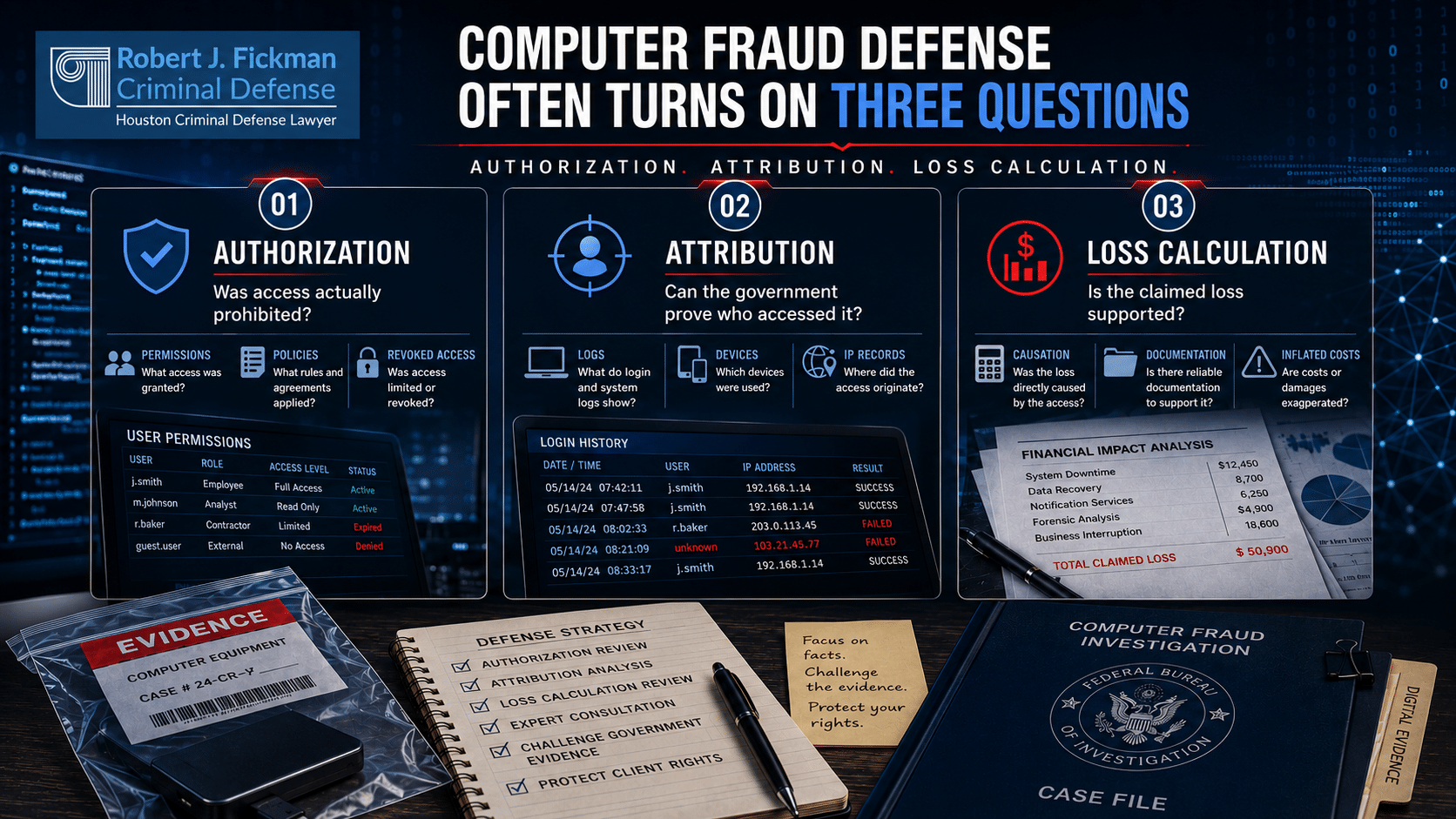
Cybercrime defense often turns on authorization and attribution. Authorization asks whether the person had permission to access the system or the specific area of the system. Attribution asks whether the government can prove the person actually performed the access at issue.
These questions are not always simple. Credentials may be shared. Devices may be used by more than one person. Accounts may stay active after employment ends. Remote access may come through VPNs, cloud platforms, personal devices, or third-party tools. Logs may show that an account was used, but not always who was physically behind the keyboard.
A defense investigation may review:
- User permissions and access levels.
- Employment agreements, access policies, and termination records.
- Server logs, IP addresses, VPN records, and login histories.
- Device ownership and shared-device issues.
- Credential sharing, password resets, and account compromise claims.
- Whether access was truly unauthorized or merely disputed after the fact.
- Whether the government can connect a specific person to a specific access event.
The government may present digital evidence as if it speaks for itself. It often does not. Logs, metadata, reports, and forensic findings must be interpreted carefully and tested against the full factual record.
Loss Calculation Can Drive Federal Exposure
Loss calculation is another major issue in federal computer fraud cases. The alleged loss amount can affect how prosecutors view the case, how the United States Sentencing Guidelines are applied, and how much pressure a defendant faces.
The government may include costs tied to investigation, response, remediation, system restoration, security review, lost revenue, customer notice, or business disruption. Some of those numbers may be contested. The defense may need to ask whether the claimed loss was actually caused by the alleged conduct, whether the amount is documented, whether it includes unrelated business costs, and whether the government has overstated the financial impact.
In a federal computer case, the loss number may be one of the most consequential figures in the file. You should not accept it without review. Robert J. Fickman Criminal Defense evaluates both the government’s access theory and its loss calculation from the outset.
Why You Should Not Speak to Federal Agents Without Counsel
Federal agents may ask questions before charges are filed. They may frame the conversation as informal or say they are only trying to understand what happened. If you are under investigation for computer fraud or cybercrime, speaking without counsel can create serious risk.
Computer cases often involve technical details, permissions, timing, credentials, business context, and logs that a person may not remember perfectly. A statement that seems harmless can later be used to prove knowledge, intent, access, or consciousness of guilt. Even a truthful but incomplete explanation can create problems if it conflicts with documents or logs the government already has.
Before speaking with agents, producing materials, consenting to a device search, or trying to explain your side, speak with an experienced federal criminal defense lawyer. For more general guidance, see Robert J. Fickman’s article on what to do if you think you may be under federal criminal investigation.
Preserve Devices, Records, and Digital Evidence
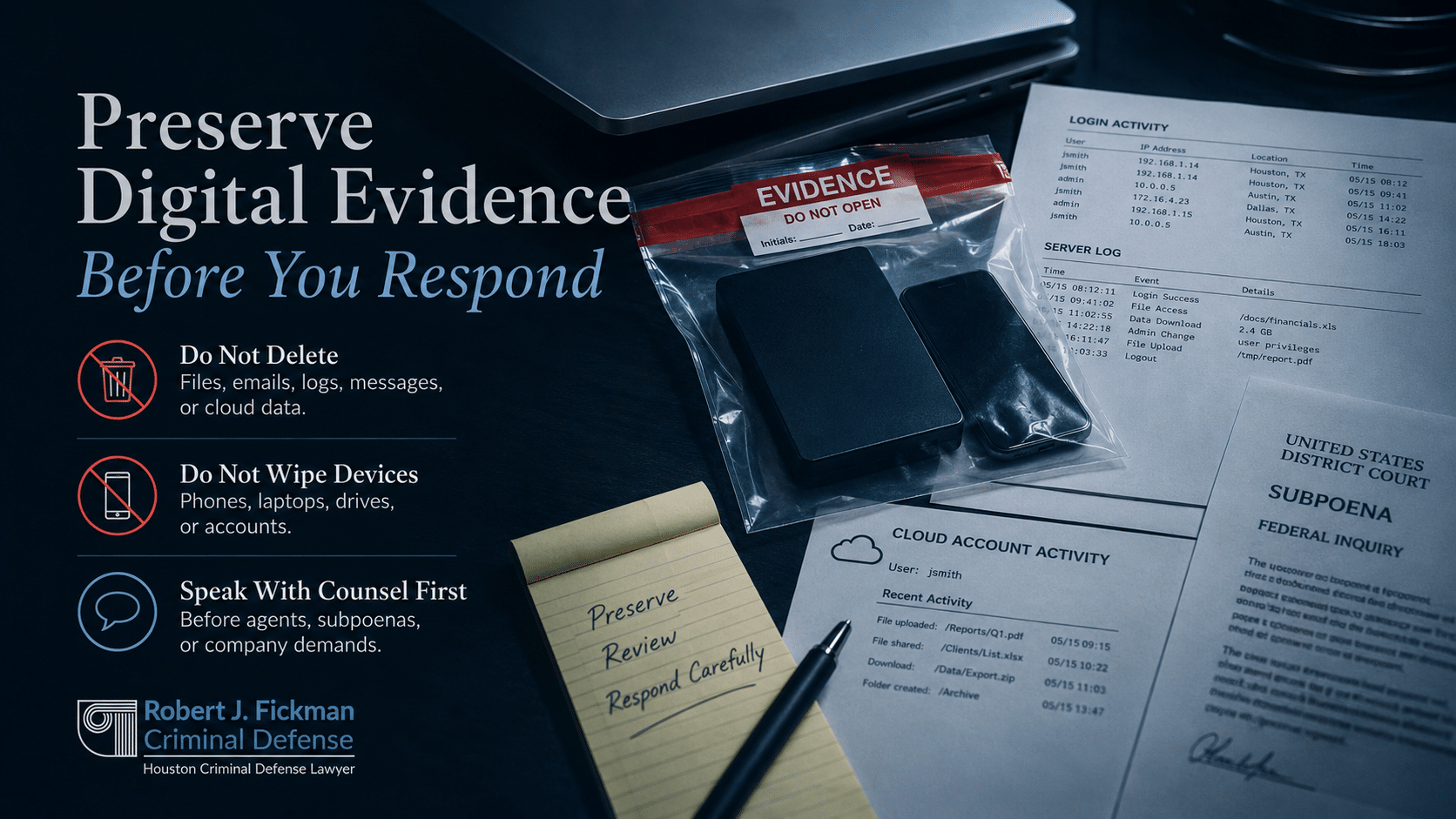
If you learn you are under investigation, do not delete, alter, wipe, reset, discard, or “clean up” devices, accounts, files, messages, logs, emails, or cloud data. Destroying or altering evidence can create separate obstruction exposure and can make the government view the case more harshly.
Preservation may include phones, laptops, desktops, external drives, company devices, personal devices, email accounts, cloud storage, source-code repositories, financial-platform records, chat applications, and business records. Do not ask anyone else to delete or modify anything either.
A defense lawyer can help you preserve relevant material while also protecting privileged communications, identifying sensitive information, and avoiding unnecessary production of materials the government has not properly requested.
How a Houston Federal Criminal Defense Lawyer Can Help
Federal computer fraud cases are often well developed before anyone is charged. Early defense involvement helps counsel assess the government’s access theory, attribution evidence, loss calculation, and charging path before the case moves further.
A federal cybercrime defense lawyer may be able to:
- Communicate with prosecutors or agents on your behalf.
- Determine whether you are a witness, subject, or target of the investigation.
- Review subpoenas, target letters, or communications from agents.
- Protect your rights before any interview or document production.
- Evaluate whether the system qualifies as a protected computer.
- Analyze authorization, access limits, and account permissions.
- Review logs, forensic reports, and digital evidence.
- Challenge attribution evidence connecting a person to an access event.
- Evaluate and contest the government’s loss calculation.
- Identify defenses based on authorization, lack of intent, mistake, consent, or overbroad charging theories.
- Develop a strategy before indictment when possible.
Early counsel can matter because cybercrime investigations often involve both technical and legal complexity. The best defense is usually not a rushed explanation. It is a careful review of the documents, devices, access records, law, and prosecutor’s theory.
Bring In a Houston Federal Criminal Defense Lawyer Before Charges Land
Federal cybercrime and computer fraud investigations can move quietly before anyone is charged. By the time agents contact you, prosecutors may already have records, logs, witness statements, subpoenas, and a developing theory of the case.
If you have been contacted by federal agents, received a subpoena, learned that your company is investigating computer access, or believe you may be accused of unauthorized access, do not wait to get legal advice. Robert J. Fickman Criminal Defense can review the situation, examine the government’s theory, and help you understand what to do next.
To discuss your situation confidentially, contact Robert J. Fickman Criminal Defense today.
Frequently Asked Questions
What makes a computer fraud case federal?
A computer fraud case may become federal when the system involved qualifies as a protected computer, which can include computers used by financial institutions or the federal government, as well as computers used in or affecting interstate or foreign commerce or communication. In practical terms, many internet-connected devices, business networks, cloud systems, and online accounts can fall within federal jurisdiction.
What does exceeding authorized access mean?
After Van Buren v. United States, exceeding authorized access generally means accessing a computer with permission but obtaining information from areas of the computer, such as files, folders, or databases, that are off limits to that person. The issue is often whether the person crossed a clear access boundary, not simply whether the access violated an employer policy or was done for an improper reason.
Can an employee be charged with federal computer fraud?
Yes, but the facts matter. Employee computer fraud cases often turn on what access the employee actually had, whether access had been revoked, whether the employee entered off-limits areas, and whether the government can prove intent, attribution, and loss.
Should I speak to federal agents about a computer access investigation?
You should speak with a federal criminal defense lawyer before talking to agents. Computer cases often involve technical facts, account permissions, logs, and timing issues. A statement made without preparation can be misunderstood or used later to prove knowledge, intent, or unauthorized access.
What should I do if I am accused of unauthorized access?
Do not delete, alter, wipe, or discard devices, files, emails, messages, logs, or cloud data. Preserve potential evidence, avoid discussing the investigation with others, and contact a federal criminal defense lawyer before responding to agents, subpoenas, or company demands.
Related