Federal investigations often begin long before a person is arrested, indicted, or formally charged. In many cases, federal agents and prosecutors may spend months reviewing records, interviewing witnesses, analyzing electronic evidence, issuing subpoenas, or presenting information to a grand jury before the person under scrutiny fully understands the seriousness of the situation.
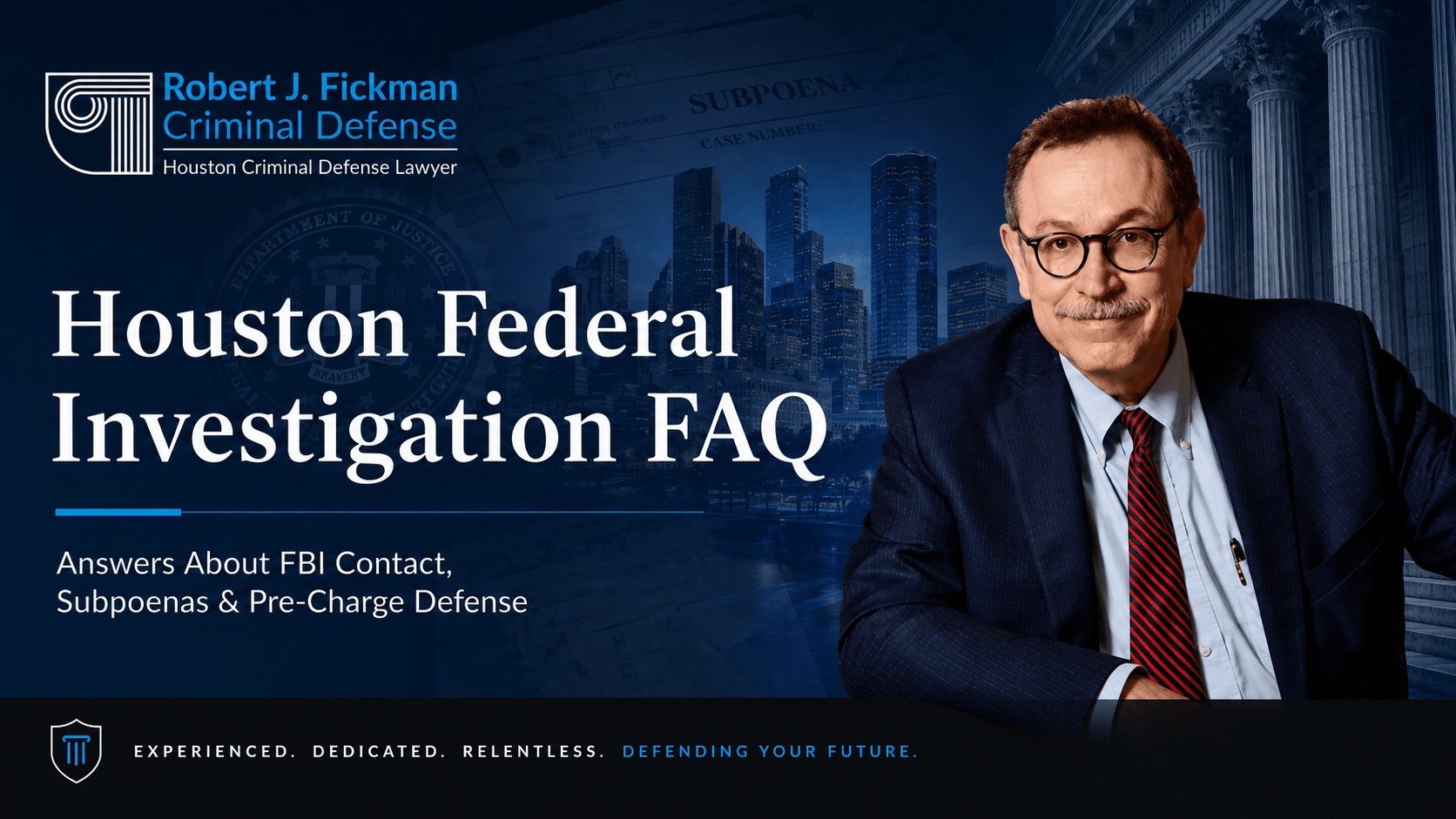
For more than 40 years, Houston criminal defense attorney Robert J. Fickman has represented individuals, professionals, and businesses facing serious state and federal criminal allegations in Texas. His federal defense work includes representing clients during active investigations, grand jury proceedings, subpoena responses, pre-indictment negotiations, and federal criminal prosecutions.
If you have been contacted by federal agents, received a subpoena, learned that others have been questioned about you, or believe you may be under investigation, early legal advice can be critical. The questions below explain common issues that arise during federal criminal investigations in Houston and the Southern District of Texas.
Questions Answered Below
What is a federal criminal investigation?
A federal criminal investigation is an inquiry conducted by federal law enforcement agencies and federal prosecutors to determine whether a person, business, organization, or group may have violated federal criminal law. These investigations may involve federal agents, grand jury subpoenas, search warrants, financial records, interviews, surveillance, digital evidence, phone records, emails, business documents, and witness statements.
Federal investigations are different from many state investigations because they often develop over a longer period of time. By the time a person receives a subpoena, is contacted by federal agents, or learns they may be a target, the government may already have gathered substantial evidence and developed a theory of the case.
Federal investigations in Houston may involve allegations related to drugs, fraud, healthcare fraud, white collar crimes, firearms, money laundering, cybercrime, immigration-related offenses, public corruption, or conspiracy. For broader information about federal prosecutions, visit the firm’s Houston federal criminal defense FAQ.
How do I know if I am under federal investigation?
You may not always know that you are under federal investigation. Federal agents and prosecutors often investigate quietly before making contact with the person they suspect. However, there are warning signs that may indicate federal scrutiny.
Possible signs of a federal investigation include:
- Federal agents contact you at home, work, or by phone
- Agents ask to interview you about business, financial, drug, healthcare, or electronic activity
- You receive a grand jury subpoena for documents or testimony
- Your business, home, phone, or computer is searched
- Employees, coworkers, business partners, patients, clients, or family members are questioned
- You receive notice that records have been requested from a bank, platform, employer, clinic, or service provider
- You are told you are a target, subject, or witness
- You learn that someone connected to you has been charged or is cooperating
A person does not need to wait for an arrest before speaking with a federal criminal defense lawyer. In many cases, the investigation stage is when legal strategy matters most.
If federal agents contact you, remain calm, be respectful, and avoid guessing, explaining, or volunteering information. You should ask for the agents’ names, agencies, contact information, and the general reason for the contact. You should not lie, destroy evidence, alter records, or attempt to influence what anyone else says.
You have the right to speak with a lawyer before deciding whether to answer questions. Even if you believe you have done nothing wrong, statements made during a federal investigation can create serious problems if they are incomplete, misunderstood, inconsistent, or later disputed by the government.
Federal agents may be professional and polite, but their job is to gather information for the investigation. Before answering questions, signing documents, producing records, or agreeing to an interview, it is usually wise to contact an experienced federal defense lawyer.
Should I talk to the FBI or federal agents without a lawyer?
In most situations, you should not speak with the FBI or other federal agents about a criminal investigation without first consulting a lawyer. A person may believe they are helping themselves by explaining the situation, but an interview can expose them to serious risks.
One major risk is that federal law makes it a crime to knowingly and willfully make materially false statements in matters within federal jurisdiction. That issue can arise even when a person is not charged with the underlying offense being investigated. Because of that risk, speaking casually or trying to “clear things up” without legal advice can be dangerous.
A lawyer can help determine whether an interview should occur, whether it should be declined, whether information should be provided in another way, and how to protect the client’s rights during the investigation.
What agencies investigate federal crimes in Houston?
Federal investigations in Houston may involve one agency or several agencies working together. Common federal agencies include the FBI, DEA, IRS Criminal Investigation, Homeland Security Investigations, ATF, Secret Service, Postal Inspection Service, HHS-OIG, Department of Labor investigators, and other federal enforcement agencies.
The agency involved often depends on the nature of the investigation. For example, healthcare fraud cases may involve HHS-OIG, FBI, or Medicaid and Medicare-related investigators. Financial crime cases may involve the FBI, IRS, Secret Service, or other agencies. Drug conspiracy cases may involve the DEA, FBI, HSI, or task force officers.
In many cases, the presence of a specific agency gives important clues about the government’s theory. A federal defense lawyer can help evaluate what type of investigation may be underway and what risks may exist.
What is the difference between a target, subject, and witness?
Federal investigations often classify people as witnesses, subjects, or targets. These labels are important, but they can also change as the investigation develops.
A witness may have information relevant to the investigation but may not be suspected of criminal wrongdoing. A subject may fall within the scope of the investigation, meaning prosecutors are examining that person’s conduct. A target is someone prosecutors believe may have committed a crime and may be considering for charges.
Even if federal agents describe someone as a witness, that does not mean the person is free from risk. A witness can become a subject or target based on documents, testimony, new evidence, or statements made during an interview. Anyone contacted in a federal investigation should take the situation seriously.
What should I do if I receive a federal subpoena?
If you receive a federal subpoena, do not ignore it. A subpoena may require you to produce documents, appear for testimony, or provide records to a federal grand jury. The United States Courts provide an official Subpoena to Testify Before Grand Jury form, and federal grand jury subpoenas should be treated as serious legal documents. Responding incorrectly can create additional legal problems.
Before producing documents or appearing to testify, a lawyer should review the subpoena, identify what it requests, evaluate privilege issues, determine whether the scope is overly broad, and assess whether compliance could expose you or your business to risk.
It may be possible to negotiate timing, clarify the scope of requested materials, object to improper requests, protect privileged information, or communicate with prosecutors through counsel. The right response depends on the facts, the subpoena, and the person’s role in the investigation.
What should I do if federal agents execute a search warrant?
If federal agents execute a search warrant at your home, business, office, clinic, or other location, you should remain calm and avoid interfering with the search. Ask to see the warrant and request a copy. Pay attention to which agency is present, what areas are searched, what items are seized, and whether agents ask questions during the search.
You should not physically obstruct agents, argue about the warrant, destroy materials, hide items, delete data, or encourage anyone else to do so. You should also avoid answering substantive questions about the investigation until you have spoken with a lawyer.
After the search, a lawyer can review the warrant, inventory of seized items, affidavit issues where available, scope of the search, potential privilege concerns, and possible defense options. Search warrants often signal that the government has already developed a serious theory of the case.
Can a lawyer help before federal charges are filed?
Yes. In many federal cases, early representation can be extremely important. A lawyer may be able to communicate with prosecutors, respond to subpoenas, protect privileged records, prepare the client for investigative issues, preserve favorable evidence, identify weaknesses in the government’s theory, and in some cases present information before charging decisions are made.
Not every federal investigation can be stopped, and no lawyer can guarantee that charges will not be filed. However, waiting until after an indictment may limit the available options. The earlier a lawyer becomes involved, the more time there may be to understand the investigation and develop a defense strategy.
For additional guidance, read more about what to do if you think you may be under federal criminal investigation.
Can a federal investigation end without charges?
Yes. Some federal investigations end without criminal charges. This can happen when prosecutors decide there is insufficient evidence, when the evidence does not prove criminal intent, when the person’s role is limited, when legal defenses affect the case, or when the government chooses not to proceed for other reasons.
In some situations, early defense work may help clarify facts, preserve evidence, respond accurately to government requests, or show why criminal charges are not appropriate. The outcome depends on the facts, evidence, investigative stage, and prosecutorial discretion.
Even when an investigation does not result in charges, the process can be disruptive, stressful, and risky. Anyone facing federal scrutiny should take steps to protect their rights early.
How long do federal investigations take?
Federal investigations can take weeks, months, or years. The length of the investigation depends on the type of case, number of people involved, volume of records, complexity of financial or digital evidence, use of grand jury subpoenas, witness cooperation, forensic review, and prosecutorial decisions.
White collar, healthcare fraud, cybercrime, drug conspiracy, and financial investigations may take longer because federal agents often review large amounts of data before making arrests or seeking indictments. In some cases, a person may not know an investigation exists until agents make contact or a subpoena arrives.
Because federal investigations can develop quietly over time, early signs should not be ignored.
What should I avoid doing during a federal investigation?
During a federal investigation, you should avoid actions that may make the situation worse. Do not lie to federal agents. Do not destroy, delete, alter, or hide documents, devices, messages, emails, files, or financial records. Do not tell other people what to say. Do not contact witnesses in a way that could be viewed as pressure or intimidation. Do not assume the government only sees you as a witness.
You should also avoid trying to explain complicated facts without legal advice. Even well-intended statements can be misinterpreted or used against you later. The safest first step is often to speak with a lawyer before communicating with agents, prosecutors, witnesses, employers, business partners, or anyone else connected to the investigation.
If you are unsure whether something is safe to say or do, stop and get legal advice before taking action.
If you have been contacted by federal agents, received a subpoena, learned that others are being questioned, or believe you may be under federal investigation in Houston or anywhere in Texas, do not wait to get legal advice.
Robert J. Fickman Criminal Defense represents individuals, professionals, and businesses in serious federal criminal investigations and prosecutions. Early defense representation can help you understand the government’s possible theory, protect your rights, and avoid mistakes that may affect the direction of the case.
Contact Robert J. Fickman to discuss your situation and begin protecting your rights.